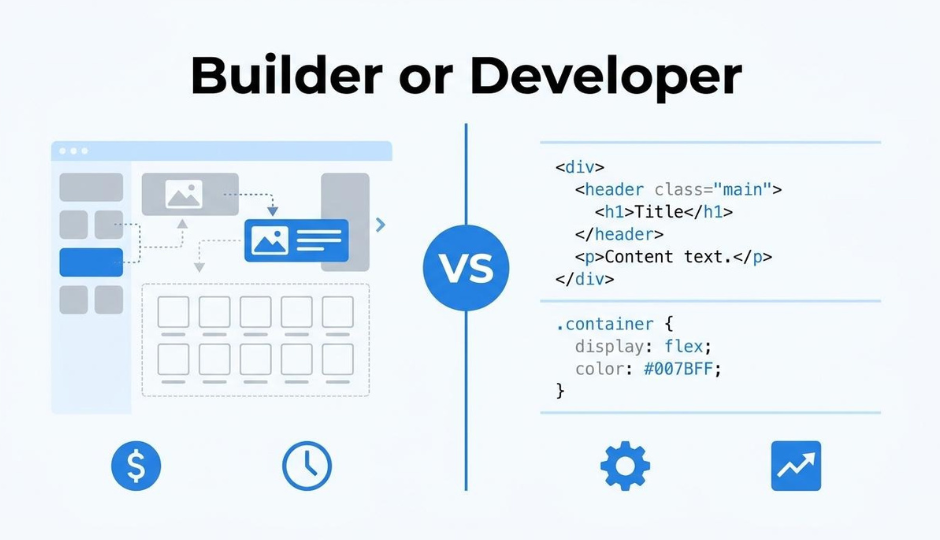
A website builder is a no-code software platform that lets users create and publish sites through visual editors and templates, while a web developer writes custom code to build features, integrations, and architectures that templates cannot deliver. Choosing between them depends on budget, timeline, technical needs, and growth trajectory.
This guide covers how each option works, the key dimensions where they differ, the scenarios that favor one over the other, and the strategic considerations that extend beyond basic site creation.
Website builders operate as SaaS platforms that bundle hosting, security, and maintenance into a single subscription. They handle the technical infrastructure automatically, making web presence accessible to founders and small business owners who lack programming skills. Custom development starts at $2,000 and scales into five figures, so builders preserve capital for brands still validating product-market fit.
The two options diverge sharply across cost, timeline, design flexibility, technical skill required, maintenance, and scalability. A DIY site can launch in a weekend; a professional build averages four to eight weeks. Builders handle ongoing updates within the subscription, while custom sites require dedicated technical support for security patches and server management.
Builders are the stronger fit for new DTC brands, budget-constrained small businesses, founders racing to market, and solo operators without technical staff. Developers become essential when a project requires proprietary integrations, advanced functionality like dynamic pricing engines, or a fully unique user experience that shared templates cannot produce.
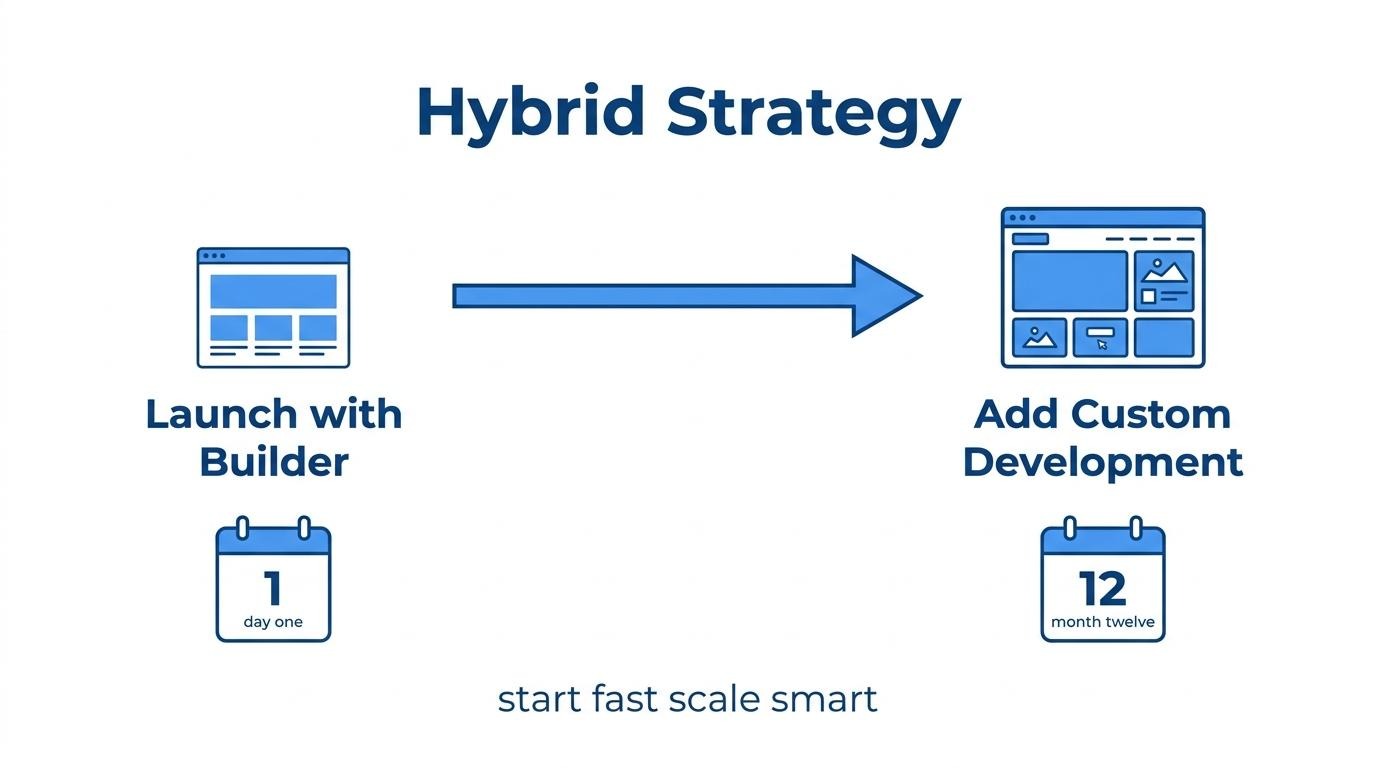
The two approaches are not mutually exclusive. Many brands launch on a builder, then bring in developers for custom features as complexity grows. The smartest choice also accounts for common decision-making mistakes, long-term scalability, and the broader operational infrastructure that surrounds a storefront.
A website builder is a software platform that lets users create, design, and publish websites without writing code. These tools work through visual interfaces, pre-built templates, and drag-and-drop editors that replace manual programming with point-and-click assembly.
Website builders handle the technical infrastructure automatically. Hosting, security certificates, domain management, and software updates run in the background while the user focuses on content and design. The user selects a template, customizes layouts and colors, adds text and images, then publishes the finished site to a live URL.
Most modern builders operate as SaaS platforms with monthly subscriptions that bundle hosting, maintenance, and customer support into a single fee. This model eliminates the need to manage separate servers or hire technical staff for routine upkeep.
The core mechanism is a visual editor that translates design choices into HTML, CSS, and JavaScript behind the scenes. When a user drags an image block into position or adjusts a font size, the platform generates the corresponding code automatically. Some builders extend this with app marketplaces, ecommerce modules, and SEO tools.
According to Gartner, by 2026 roughly 80% of technology products and services will be built by people who are not professional software developers. Website builders sit at the center of this shift, making web presence accessible to business owners, marketers, and entrepreneurs who lack programming skills.
That accessibility comes with trade-offs, however. Template-based design constrains layout options, and platform-generated code may not match the performance optimization a developer can achieve by hand. For straightforward sites like portfolios, small business landing pages, or basic online stores, these limitations rarely matter. For brands requiring custom integrations or complex functionality, the constraints become more significant, which is where hiring a web developer enters the conversation.
A web developer writes custom code to build website features, integrations, and architectures that fall outside the scope of any template-based platform. Where a website builder provides pre-designed components, a web developer creates original solutions from scratch using languages like HTML, CSS, JavaScript, and server-side frameworks.
This distinction matters most in three areas: custom functionality, unique design execution, and complex third-party integrations. A web developer can build proprietary checkout flows, connect disparate backend systems through custom APIs, or engineer a database architecture tailored to specific business logic. These capabilities sit beyond what drag-and-drop editors offer, regardless of the platform.
According to Mordor Intelligence, the web development services market was valued at USD 80.6 billion in 2025 and is estimated to reach USD 134.17 billion by 2031 at a CAGR of 8.87%. That growth reflects rising demand for bespoke digital experiences that templates alone cannot deliver.
The core tasks a web developer handles that a builder cannot include:
For brands operating at scale with complex operational requirements, these capabilities become essential rather than optional. A website builder handles the common 80% of web design needs efficiently, but the remaining 20%, where business logic, data handling, or UX requirements deviate from standard patterns, is where custom development earns its value.
Understanding this boundary between builders and developers is the foundation for comparing them across specific dimensions like cost, timeline, and scalability.
The key differences between a website builder and a web developer span cost, timeline, design flexibility, technical skill, maintenance, and scalability. Each factor shifts depending on project complexity and budget.
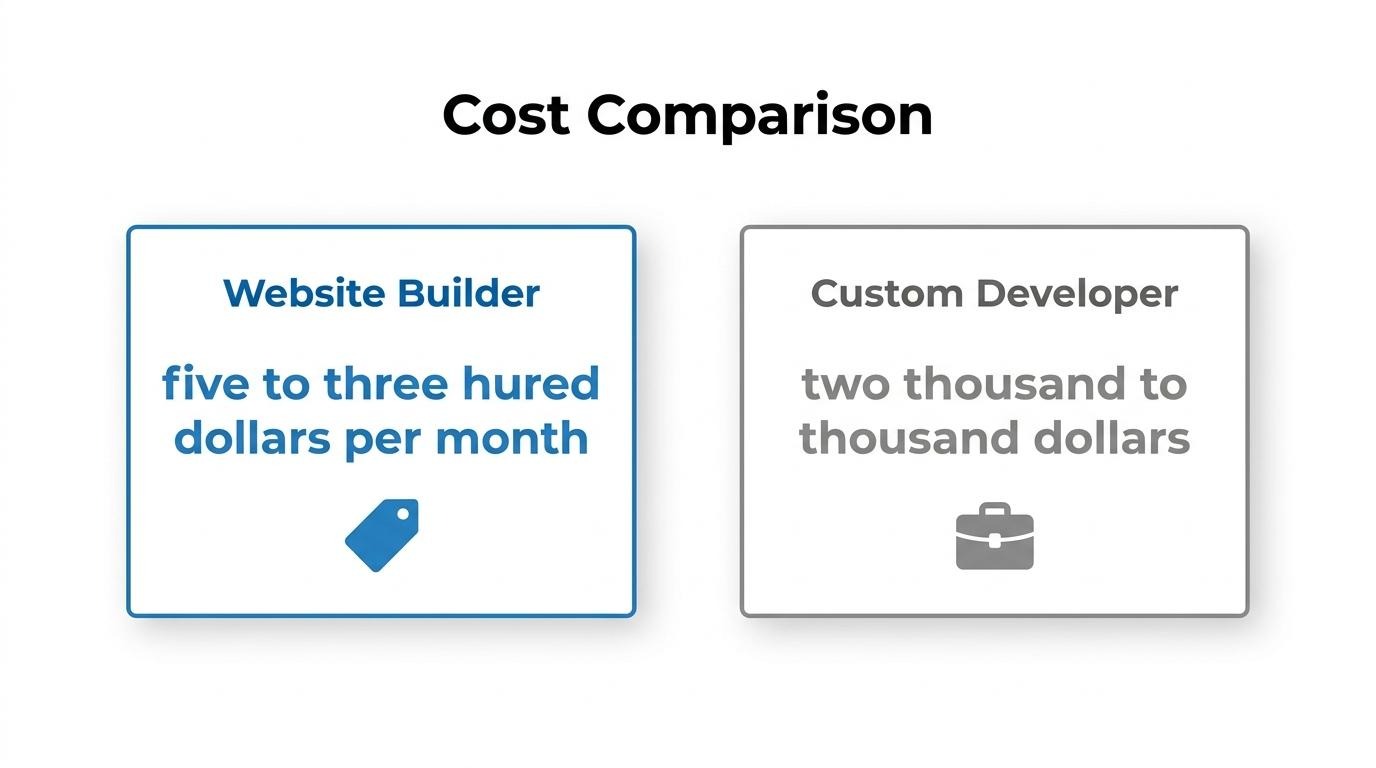
Website builders and web developers compare on cost with a significant gap. Builders typically charge $5 to $300 per month, covering hosting, templates, and basic features in one subscription. According to the U.S. Small Business Administration, a typical custom website price starts at $2,000 and can go into five figures, which is significantly higher than a DIY website.
The price difference compounds when you factor in ongoing developer retainer fees for updates and bug fixes. For brands operating below seven figures in revenue, that upfront custom development cost is difficult to justify when builder platforms deliver functional storefronts at a fraction of the price.
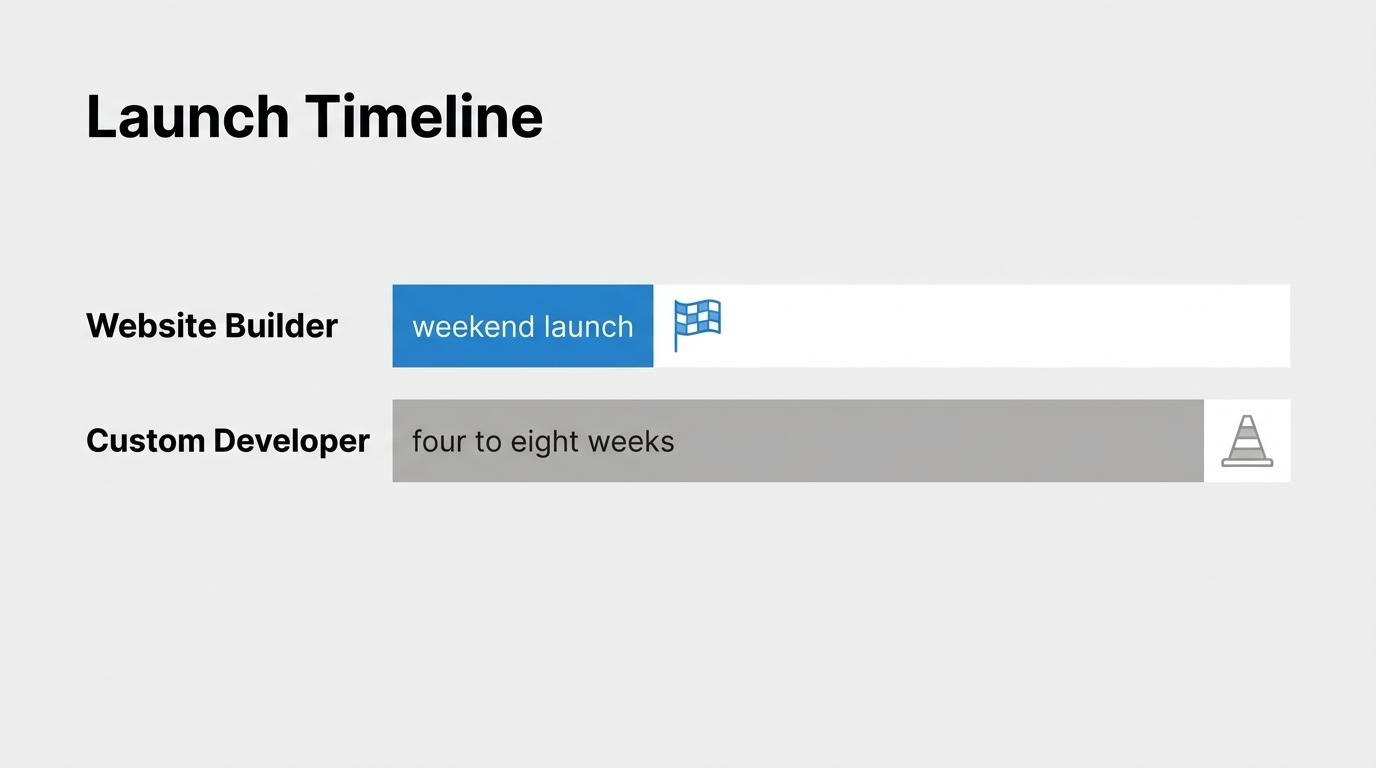
Website builders and web developers compare on timeline with a dramatic difference. According to Elementor, a simple DIY site can be built in a weekend, while a standard multi-page small business website averages 4 to 8 weeks when working with a professional developer.
That gap widens for complex projects requiring custom integrations, API connections, or bespoke checkout flows. Builder platforms compress timelines because they eliminate design-from-scratch phases, server configuration, and QA testing cycles. For brands racing to validate a product or capture seasonal demand, weeks of development delay carry real opportunity cost.
Website builders and web developers compare on design flexibility at opposite ends of the spectrum. Builders offer pre-designed templates with drag-and-drop customization, while developers create layouts from scratch with no constraints. A Northern Arizona University study found that credibility judgments on a website are 75% based on overall visual appearance, which raises the stakes for design quality regardless of method.
Templates work well for standard layouts, but they impose structural limits on navigation patterns, animation, and interactive elements. When a brand's identity demands a completely unique visual experience, custom development delivers that precision. For most standard ecommerce or service sites, though, modern builder templates are more than adequate.
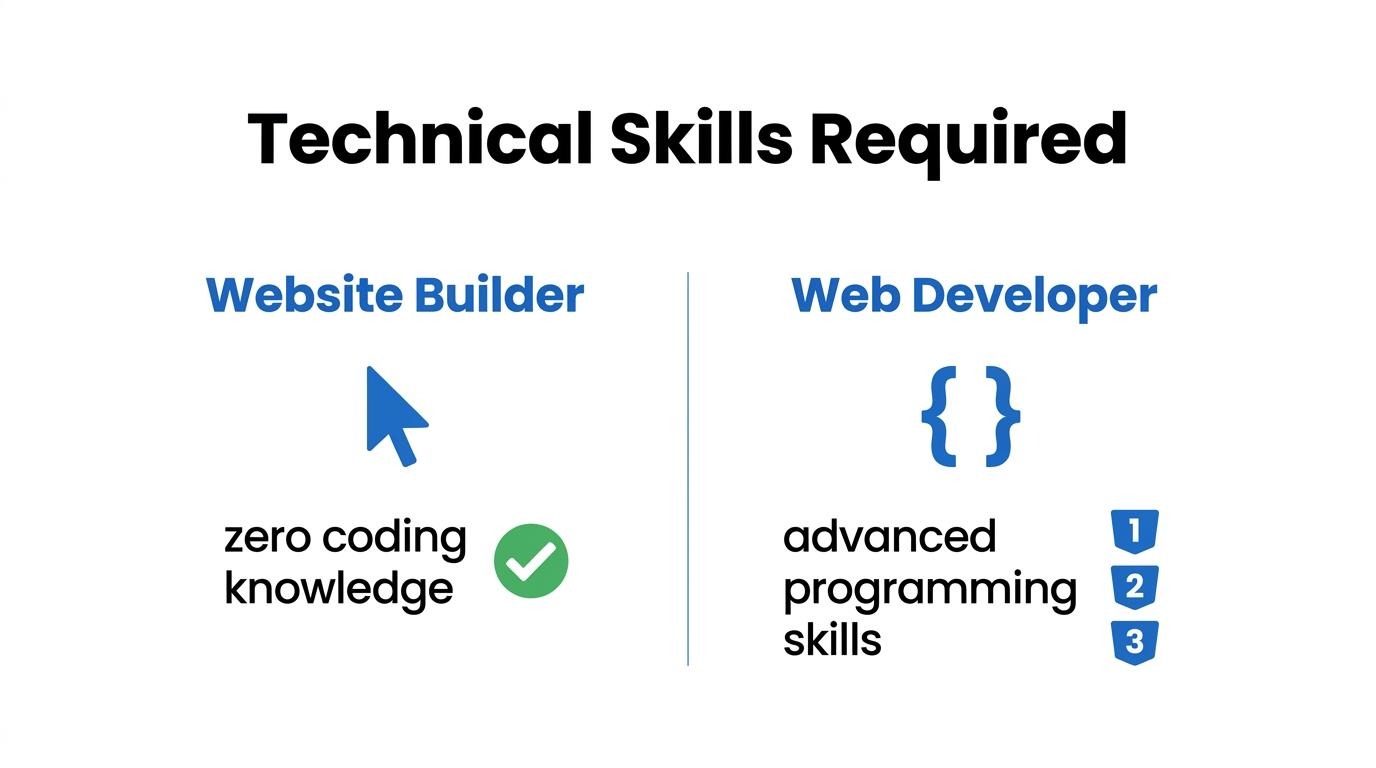
Website builders and web developers compare on technical skill required at fundamentally different levels. Builders require zero coding knowledge; users select templates, add content through visual editors, and publish without touching HTML, CSS, or JavaScript. Web developers need proficiency in front-end and back-end programming languages, server management, database architecture, and version control systems.
This gap makes builders accessible to anyone with basic computer literacy, while custom development demands either personal technical expertise or the budget to hire it. For non-technical founders, the learning curve of working with a developer also includes communicating requirements effectively through briefs and wireframes.
Website builders and web developers compare on ongoing maintenance in terms of who bears the responsibility. Builders handle hosting, security patches, SSL certificates, and platform updates automatically within the subscription. Custom-built sites require the owner or a hired developer to manage server upkeep, plugin compatibility, security monitoring, and software updates manually.
According to GoDaddy, website maintenance costs range from $5 per month for basic sites to several thousand monthly for large, high-traffic websites, with small to medium businesses averaging $50 to $500 per month. Neglected maintenance on custom sites creates security vulnerabilities, while builder platforms absorb that risk as part of their service model.
Website builders and web developers compare on scalability with different ceilings. Builders scale effectively for standard ecommerce growth, handling increased traffic, product catalogs, and payment processing within platform infrastructure. Custom-developed sites scale without architectural limits because developers can optimize databases, implement custom caching, and build microservices tailored to specific performance demands.
The practical distinction matters most at high transaction volumes or when a site requires deep integrations with enterprise systems like ERPs, warehousing software, or custom analytics pipelines. Most brands will not hit builder platform limits until well past seven figures in annual revenue. For brands approaching that threshold, evaluating whether the platform or custom code better serves long-term growth becomes a strategic decision.
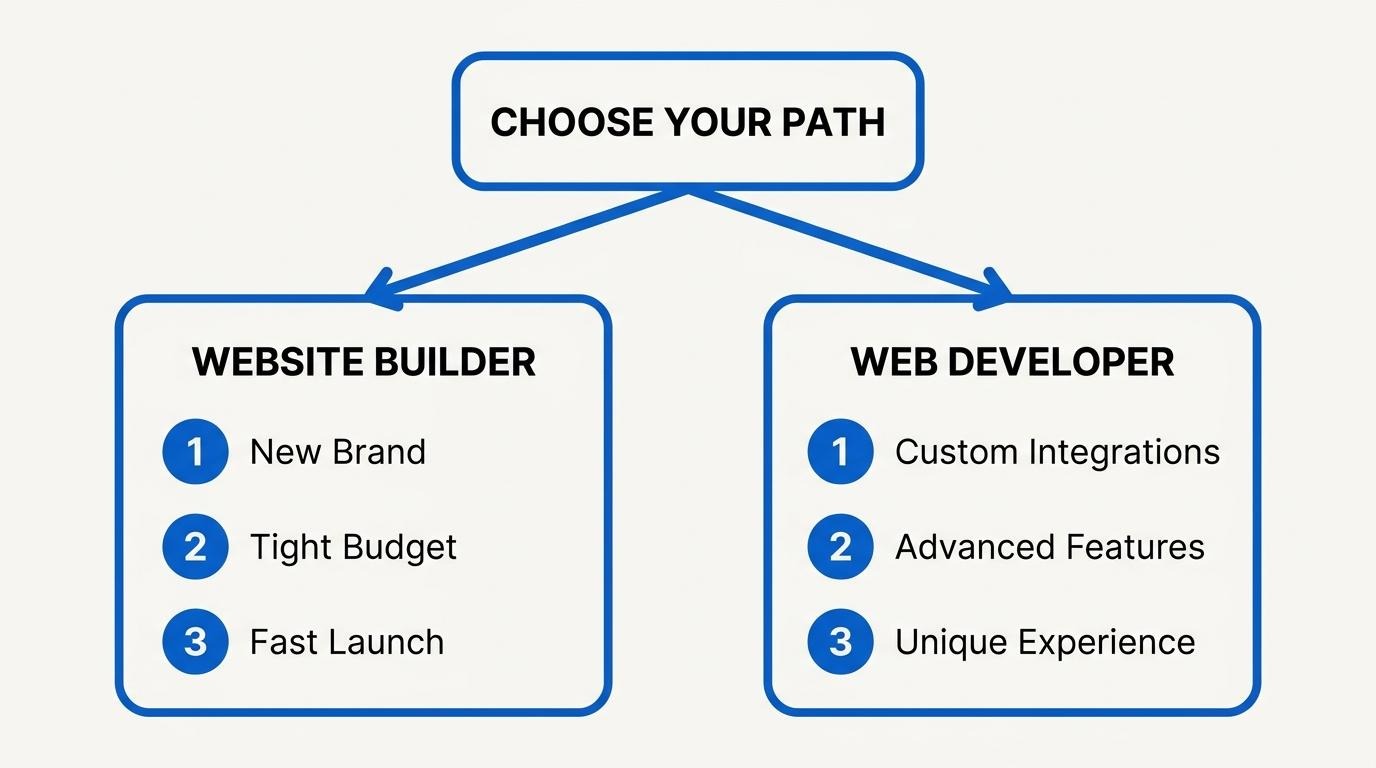
You should choose a website builder over a web developer when your priority is speed, affordability, and independence from technical staff. The scenarios below cover new DTC brands, budget-constrained small businesses, time-sensitive launches, and solo operators.
A new DTC brand should use a website builder when it needs a professional storefront without upfront development costs or technical complexity. Modern builders include ecommerce templates, payment processing, and product management in a single subscription.
AI-powered features are accelerating this trend. According to Custom Market Insights, AI-based website builders grew from roughly 11% market share in 2022 to 23.6% in 2024, giving new brands access to design assistance and content generation without hiring specialists. Leading builder platforms also score well above the global 53% average on Core Web Vitals, so storefront performance remains competitive out of the box.
For a brand still validating product-market fit, a builder preserves capital for inventory, marketing, and customer acquisition rather than a five-figure custom build.
A small business on a limited budget should use a builder when a custom website's cost would consume a disproportionate share of available capital. According to the U.S. Small Business Administration, a typical custom website starts at $2,000 and can reach five figures, while a DIY builder often costs under $50 per month.
Ongoing expenses widen the gap further. Maintenance for small to medium business sites averages $50 to $500 monthly, and a builder handles hosting, security patches, and software updates within that subscription fee. A simple DIY site can also launch in a weekend rather than the four to eight weeks a professional build typically requires. That speed-to-revenue difference matters when cash flow is tight.
A founder who needs to launch quickly should use a builder when time-to-market directly affects revenue, funding milestones, or competitive positioning. Builders compress the launch timeline from weeks to days by eliminating the developer hiring process, design handoffs, and QA cycles.
Seasonal product drops, crowdfunding campaigns, and investor demos all demand rapid execution. A founder can select a template, configure products, connect a payment gateway, and go live within a single weekend. Iterating on design or adding pages afterward requires no developer involvement, which keeps momentum high during early traction phases when every week counts.
A solo operator without technical staff should use a builder when there is no internal team to write code, manage hosting, or troubleshoot server issues. Website builders handle the entire technical infrastructure, from SSL certificates to mobile responsiveness, inside a visual drag-and-drop interface.
This self-sufficiency extends to daily operations. Product updates, blog posts, promotional banners, and SEO adjustments all happen through the same dashboard without submitting tickets to a freelancer. According to SiteBuilderReport, over 18 million websites are built using DIY builders, reflecting how widely non-technical operators rely on these platforms. For a solo operator, eliminating developer dependency means faster decisions and lower overhead at every stage.
Understanding when a builder fits best clarifies when a developer becomes essential instead.
You should hire a web developer when your project demands custom integrations, advanced functionality, or a fully unique user experience that template-based platforms cannot deliver. The following scenarios clarify when professional development is the right investment.
A brand with complex custom integrations should hire a developer when off-the-shelf connectors and built-in tools cannot support its required data flows. Businesses running proprietary ERP systems, custom inventory logic, or multi-warehouse fulfillment workflows often need server-side code that no drag-and-drop editor provides.
According to Mordor Intelligence, the web development services market was valued at USD 80.6 billion in 2025 and is estimated to reach USD 134.17 billion by 2031, reflecting growing demand for tailored digital infrastructure. This growth signals that more businesses are encountering integration complexity that standard platforms were never designed to handle. If your stack requires real-time data synchronization across systems with no pre-built API connector available, a developer is essential.
A business needing advanced functionality should hire a developer when the required features exceed what templates and plugins can reliably deliver. Custom pricing engines, dynamic product configurators, multi-currency checkout logic, and proprietary recommendation algorithms all demand hand-written code.
Designing within a no-code platform often means working within specific constraints, such as limited performance optimization or predefined design components, according to Aubergine. These constraints become liabilities when functionality directly drives revenue. For most scaling ecommerce operations, the tipping point arrives when workarounds and third-party plugins introduce more fragility than the feature they were meant to provide.
A company requiring unique UX should hire a developer when brand differentiation depends on interaction patterns, animations, or page structures that templates cannot produce. Custom scroll behaviors, immersive product storytelling, and non-standard navigation all require front-end development beyond visual editors.
Template-based designs share layout DNA across thousands of sites, which limits how distinctive a brand can feel. Given that 42% of users leave a site because of poor functionality, according to GoodFirms, the stakes of a generic or constrained experience are measurable. When the user journey itself is a competitive advantage, investing in bespoke development pays for itself through engagement and conversion gains that templated alternatives simply cannot match.
Understanding when custom development is necessary also helps clarify when a hybrid approach might be the smartest path forward.
Yes, you can use a website builder and a web developer together. A hybrid approach lets businesses launch quickly on a builder platform, then bring in a developer for custom features, integrations, or performance optimization as needs grow. Many scaling brands start with a builder's drag-and-drop foundation and later hire developers to extend functionality through custom code, API integrations, or bespoke UX elements. This combination balances speed and affordability with long-term technical depth. According to Gartner, by 2026 roughly 80% of technology products and services will be built by people who are not professional software developers, reflecting how builder platforms handle the baseline while specialists focus on complex requirements. For brands operating at real volume, the practical question is not which tool to choose permanently, but when each resource delivers the most value across a site's lifecycle.
The most common mistakes when choosing between a website builder and a web developer involve misjudging project scope, underestimating long-term costs, and selecting based on short-term needs rather than growth trajectory. Many businesses either overspend on custom development they don't need or outgrow a builder within months because they didn't account for future complexity.
One frequent error is defaulting to the cheapest option without calculating total cost of ownership. According to the U.S. Small Business Administration, a typical custom website starts at $2,000 and can reach five figures, which makes builders seem like the obvious choice. However, businesses that start on a basic builder and later need custom integrations, advanced e-commerce logic, or unique user experiences often spend more on migration and rebuilding than they would have on a properly scoped developer project from the start.
Another common mistake is hiring a web developer for a straightforward site that a builder handles well. Not every business needs custom code. A five-page service site or a standard online store with templated layouts rarely justifies the 4-to-8-week timeline and higher upfront investment that professional development requires. Conversely, choosing a website builder for a project requiring complex third-party integrations or custom database architecture creates technical debt that compounds over time.
Businesses also underestimate ongoing maintenance demands. Selecting a platform without considering who will handle updates, security patches, and content changes leads to either neglected sites or unexpected costs. A builder centralizes these tasks for non-technical teams, while a developer-built site typically requires continued technical support.
Perhaps the most overlooked mistake is ignoring scalability. A site that works at launch may buckle under increased traffic, product catalog growth, or multichannel selling demands. The right choice depends not on where a business is today, but on where it realistically expects to be in 12 to 24 months. Matching the solution to the growth roadmap, not just the current budget, prevents costly pivots later.
Understanding these pitfalls makes evaluating the broader ecosystem around ecommerce platforms far more productive.
Ecommerce brands should consider the operational infrastructure that surrounds a storefront, not just the storefront itself. The subsections below cover how consolidated platforms reduce tool sprawl and the core takeaways from the website builder vs. web developer decision.
SHOPLINE reduces tool sprawl by consolidating commerce, CRM, marketing automation, subscriptions, and POS into a single system with a shared customer data layer. Instead of stitching together separate apps for email marketing, recurring billing, loyalty programs, and point-of-sale, scaling DTC brands operate from one platform where online and offline data resolve to the same customer record.
For brands running $1M to $50M+ in annual revenue, this consolidation addresses a common pain point: fragmented data spread across five to fifteen disconnected tools. SHOPLINE is one option for brands that have outgrown the app-stack approach and need to reduce operational complexity without sacrificing functionality.
The key takeaways about website builders vs. web developers center on matching the right approach to your budget, timeline, technical needs, and growth trajectory.
The smartest choice often evolves alongside the business. Prioritize the decision that serves your current stage while leaving room for the operational complexity that growth inevitably brings.