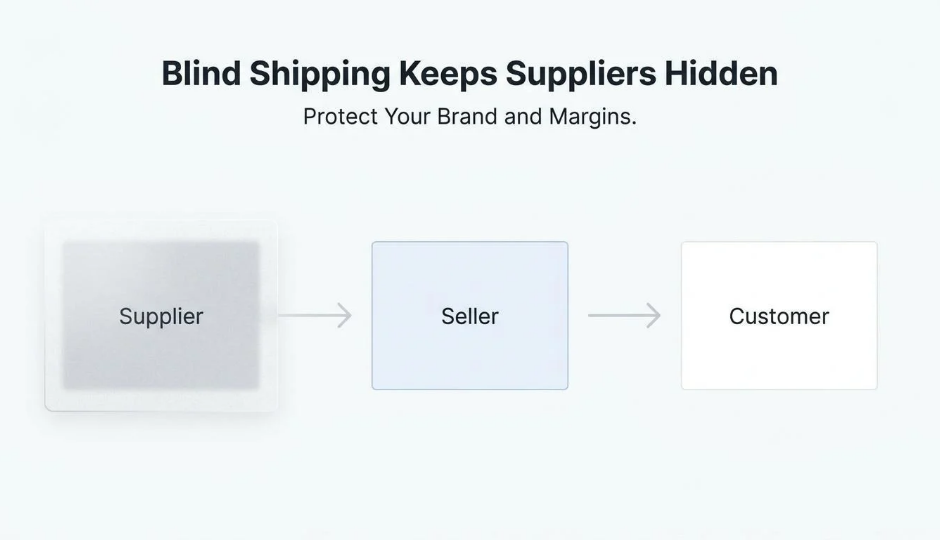
Blind shipping is a fulfillment method where the seller removes the supplier's identifying information from all shipping documents and packaging before the order reaches the customer. The customer sees only the seller's branding, never the original manufacturer or warehouse. According to FedEx's shipping glossary, blind shipments keep supplier details confidential, and the shipper and/or consignee don't know who sent or received the goods. This approach is commonly used for drop shipping, third-party logistics, and wholesale distribution. For brands that rely on external suppliers, blind shipping preserves the perception that every order ships directly from the brand itself, which protects both supplier relationships and retail pricing strategies.
The blind shipping process works through coordinated steps between seller, carrier, and supplier. Each stage ensures supplier details stay hidden from the end customer. The subsections below cover order preparation, carrier paperwork handling, and what the customer ultimately receives.
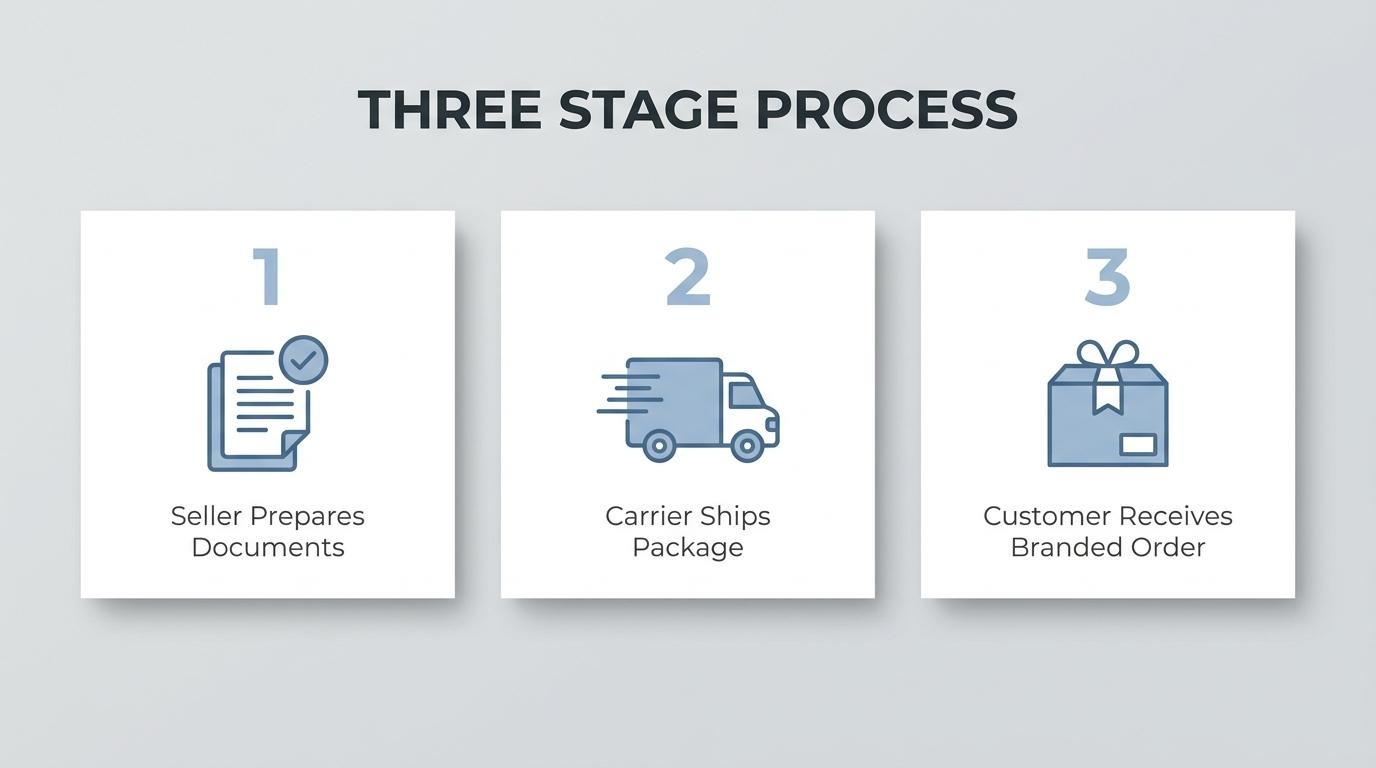
The seller prepares a blind shipment order by creating modified shipping documents that replace the supplier's information with the seller's own branding. This includes generating a bill of lading, packing slip, and shipping label that list the seller as the shipper of record.
Key preparation steps include:
According to DHL Freight Connections, a double blind shipment hides the identity of both shipper and buyer from each other, meaning the shipper sends goods without knowing the buyer's exact delivery address while the buyer never learns who shipped the goods. Careful document preparation at this stage is what makes the entire downstream process seamless.
The freight carrier handles blind shipping paperwork by processing shipping documents that show the seller's information instead of the original supplier's details. The carrier picks up the shipment, references the modified bill of lading, and delivers based on the addresses provided.
As Lehigh University College of Business notes, the vendor ships the product directly to the customer, and at no time is the product ever in the retailer's inventory or physically handled by the retailer. The carrier's role is purely logistical: it follows the paperwork without questioning the relationship between parties. Because the documentation lists the seller as the shipper, tracking information and delivery confirmations also reflect the seller's identity rather than the supplier's.
The end customer receives the products ordered in packaging that displays the seller's branding, with no visible trace of the original supplier. Packing slips, invoices, and return labels all reference the seller. From the customer's perspective, the experience is identical to ordering directly from the seller's own warehouse. This consistency reinforces brand trust and eliminates confusion about where the product originated. For brands scaling through third-party fulfillment, maintaining this perception of direct fulfillment is what separates a professional operation from one that exposes its supply chain to the buyer.
With the process steps clear, the next distinction to understand is how blind shipping compares to double blind shipping.
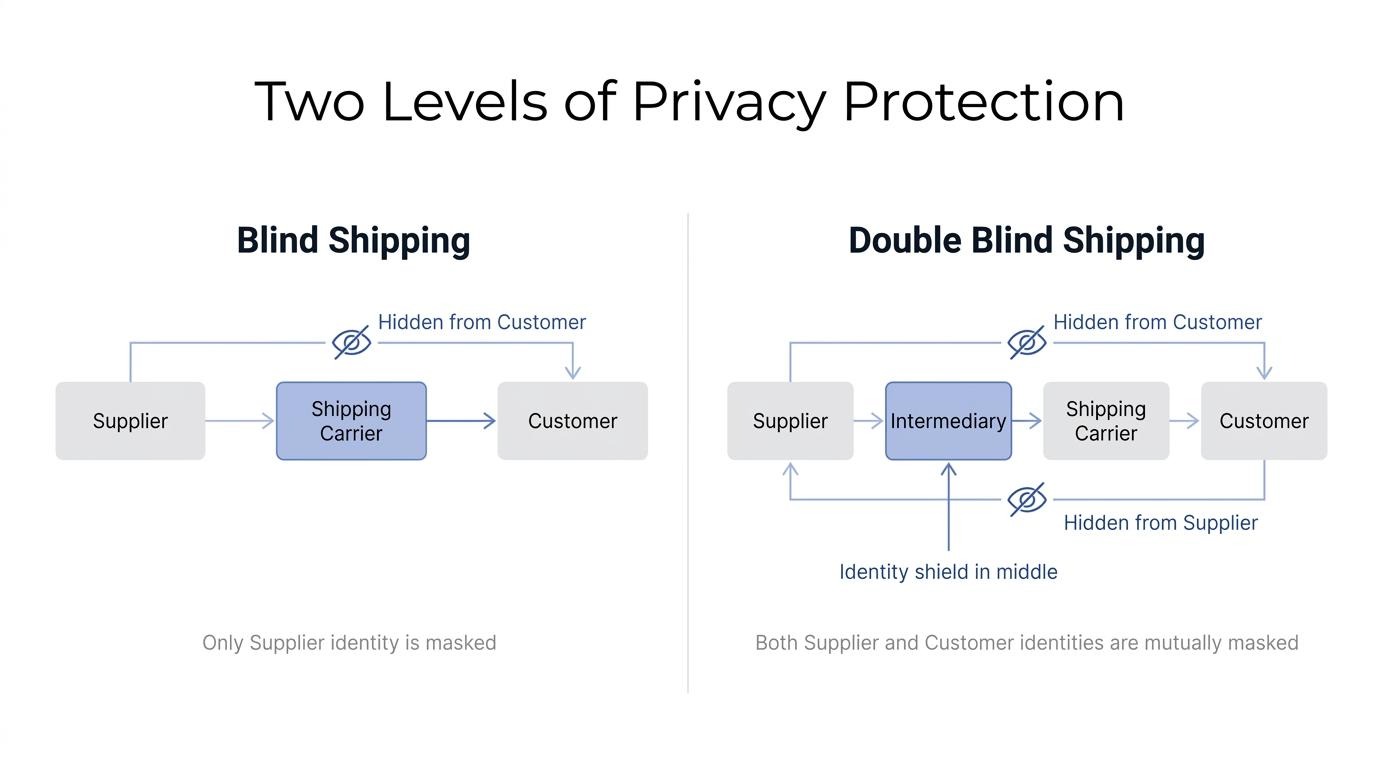
The difference between blind shipping and double blind shipping is the number of parties kept in the dark. Blind shipping hides the supplier's identity from the end customer, while double blind shipping hides both the supplier's identity from the buyer and the buyer's identity from the supplier.
According to the FedEx Freight Glossary, blind shipments keep supplier details confidential and are commonly used for drop shipping, third-party logistics, and wholesale distribution. In a standard blind shipment, the customer sees only the seller's branding on shipping documents; the supplier's name, address, and pricing never appear.
Double blind shipping adds a second layer. As DHL Freight Connections defines it, a double blind shipment occurs when a distributor hides the identity of both the shipper and the buyer from each other. The shipper sends the package without knowing the exact delivery address, and the buyer does not know who directly shipped the goods. The intermediary (typically the seller or a 3PL) coordinates both sides, issuing separate documentation to each party.
This distinction matters most for sellers managing complex supply chains. When last-mile costs accounted for 53% of total shipping costs in 2023, according to a World Economic Forum report (up from 41% in 2018), every layer of fulfillment coordination carries real financial weight. Double blind shipping requires more administrative oversight, including two sets of bills of lading and careful label management, but it offers the strongest confidentiality protection in multi-party distribution networks.
For most ecommerce brands using a single supplier, standard blind shipping provides sufficient confidentiality. Double blind shipping becomes essential when the seller sources from manufacturers who also sell direct, or when protecting proprietary distribution relationships across competing channels.
Understanding which model fits your fulfillment structure helps clarify the broader advantages blind shipping offers any growing brand.
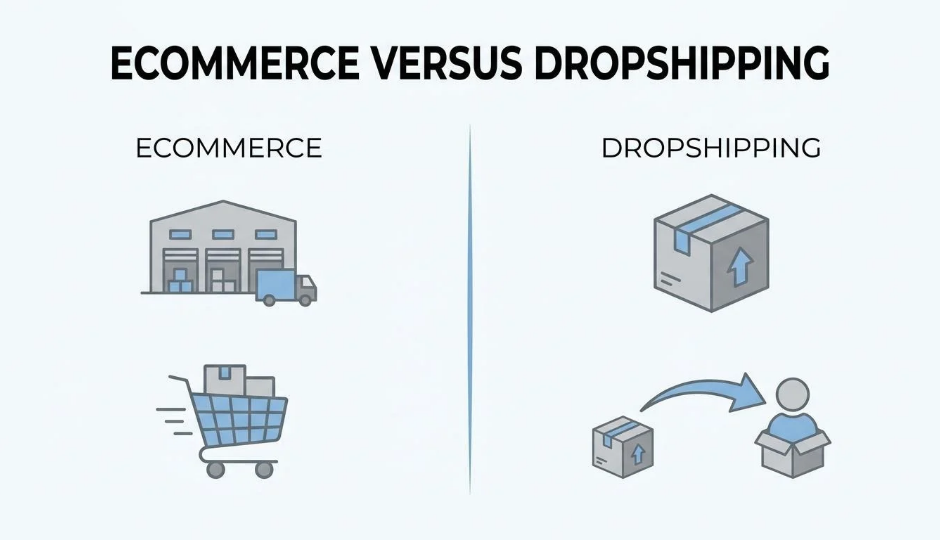
Blind shipping differs from drop shipping in focus: blind shipping is a labeling and documentation method that hides supplier identity, while drop shipping is a fulfillment model where a third party ships orders directly to customers. The two often overlap but serve distinct purposes.
Drop shipping defines who fulfills the order. According to Lehigh University's College of Business, in drop shipping the vendor ships the product directly to the customer, and at no time does the retailer actually handle the product. The process follows a clear sequence:
Blind shipping, by contrast, defines what the customer sees. It can be applied within a drop shipping arrangement or independently in wholesale distribution and third-party logistics. The core distinction is that blind shipping modifies shipping labels and documents so the supplier's identity stays hidden, while drop shipping restructures fulfillment responsibility entirely.
Many ecommerce sellers combine both: they use drop shipping as the fulfillment model and layer blind shipping on top to protect branding. However, a retailer who warehouses its own inventory can also blind ship when forwarding orders from a secondary supplier. Drop shipping without blind shipping exposes the manufacturer's name on packaging, which risks the customer bypassing the retailer on future orders.
For brands scaling beyond a single fulfillment source, understanding this distinction matters. Blind shipping is a tactical layer that preserves brand presentation regardless of who physically ships the goods.
Ecommerce businesses use blind shipping to protect supplier relationships, maintain brand control, safeguard margins, and deliver a seamless customer experience. The following sections break down each of these core motivations.
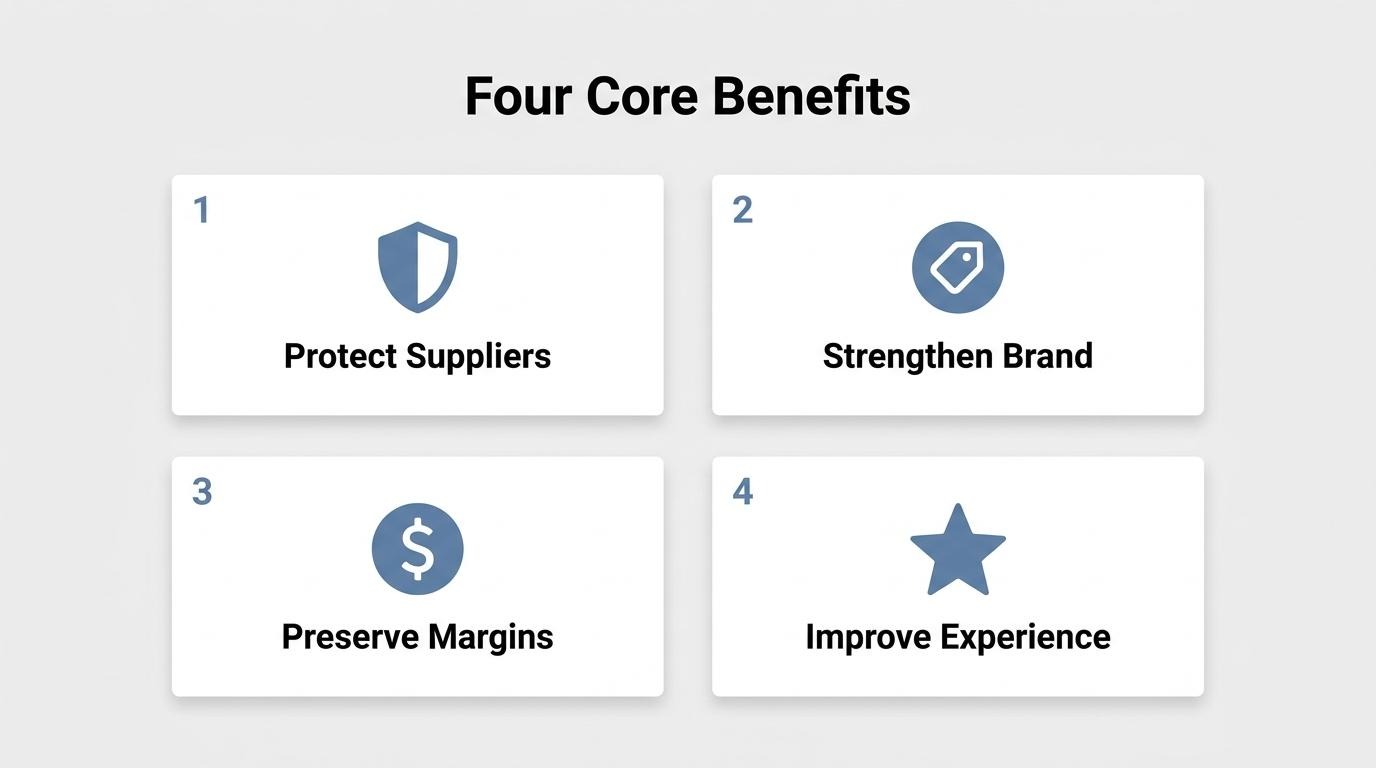
Blind shipping protects supplier identity by removing the supplier's name, address, and contact details from all shipping labels and packing slips before the package reaches the customer. The seller replaces this information with its own branding or a neutral placeholder. Without these safeguards, customers could contact the supplier directly to reorder, bypassing the retailer entirely. For businesses that rely on exclusive sourcing arrangements or negotiate preferential pricing, even a single exposed supplier detail can undermine a competitive advantage built over years. Keeping the supply chain invisible to the end buyer is one of the simplest ways to defend long-term sourcing relationships.
Blind shipping strengthens brand consistency by ensuring every package a customer receives carries the seller's identity rather than a third-party supplier's. When branded packing slips, labels, and inserts replace generic supplier materials, the unboxing experience reinforces the retailer's visual identity and messaging. This matters most for DTC brands competing on perception and trust. A package arriving with an unfamiliar company name creates confusion, erodes credibility, and disrupts the story the brand built through its website and marketing. Blind shipping turns the fulfillment touchpoint into a brand extension, keeping the customer relationship anchored to the seller from checkout through delivery.
Blind shipping helps preserve profit margins by preventing customers from discovering wholesale pricing or supplier cost structures. If a buyer identifies the original manufacturer, a quick search can reveal the wholesale price, making the retailer's markup transparent. That visibility invites price comparison, erodes perceived value, and increases the likelihood of customer churn to cheaper sources. By keeping sourcing details hidden, sellers maintain pricing authority. This is especially critical for brands operating in competitive categories where differentiation rests on curation, service, or brand story rather than on manufacturing exclusivity alone.
Blind shipping improves the customer experience by presenting a cohesive, branded interaction from purchase to delivery. When packaging, labels, and documentation all reflect the seller's identity, the customer perceives a single, trustworthy source rather than a fragmented supply chain. According to Penn State Extension, the effectiveness of online order packaging, shipping, and pick-up coordination directly impacts customer satisfaction. Confusion caused by unfamiliar sender names or mismatched branding often triggers unnecessary support tickets and erodes trust. By eliminating these friction points, blind shipping reduces post-purchase anxiety and reinforces the buying decision.
With the benefits clear, understanding the risks and challenges of blind shipping helps brands implement it effectively.
The risks and challenges of blind shipping include delivery errors that are harder to resolve, complex return workflows, and coordination gaps between sellers and suppliers. Each of these issues can erode customer trust if left unmanaged.
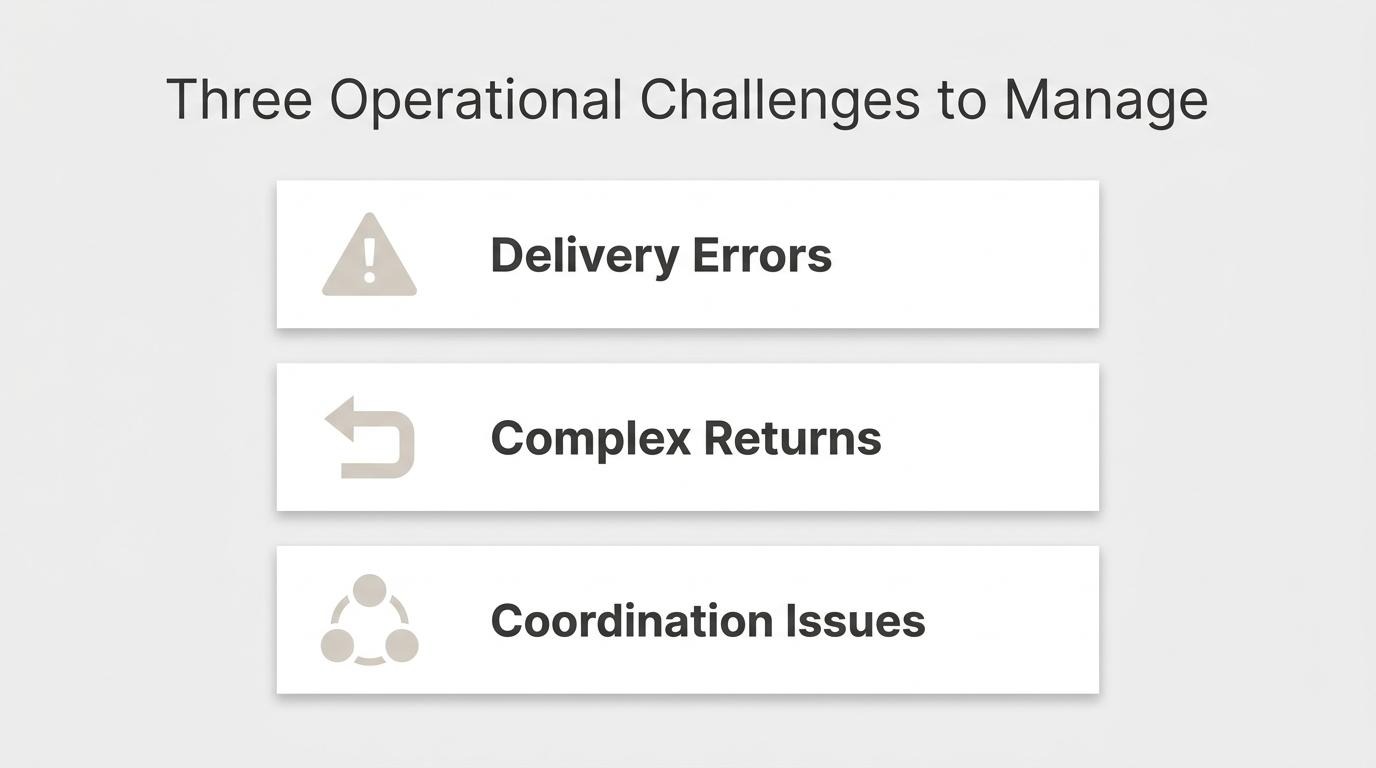
A blind shipment delivery error occurs when incorrect addresses, mislabeled packages, or wrong products reach the customer, and the seller has limited visibility because the supplier handled fulfillment. Diagnosing the root cause takes longer since the seller must relay information between the customer and the supplier without exposing supplier identity.
Common delivery errors in blind shipping include:
Because each correction passes through an intermediary, resolution times stretch considerably. For scaling brands, automating order data handoffs between seller and supplier systems is the single most effective way to reduce these errors before they reach the customer.
Returns and exchanges with blind shipping require a carefully structured reverse logistics process because the customer cannot ship products directly back to the supplier without revealing supplier identity. The seller must provide a return address, often a warehouse or intermediary location, then coordinate the return with the supplier separately.
According to the FTC's Mail, Internet, or Telephone Order Merchandise Rule, when a seller cannot ship within the promised time, the seller must obtain the buyer's consent to a delay or refund payment for the unshipped merchandise. This obligation applies equally to replacement shipments during exchanges.
Key steps in a blind shipping return process:
Reverse logistics is often underestimated in blind shipping setups, yet it directly impacts customer retention and operational cost.
Coordination issues between seller and supplier in blind shipping stem from information asymmetry, misaligned timelines, and fragmented communication channels. The seller controls the customer relationship and branding requirements while the supplier controls inventory, packing, and shipping execution.
Frequent coordination breakdowns include:
According to the Sam M. Walton College of Business at the University of Arkansas, it is crucial that businesses coordinate all delivery stakeholders to ensure the system aligns with customer needs. Without shared, real-time order data, sellers and suppliers operate from different versions of truth, which compounds errors at scale.
Understanding these coordination risks prepares sellers to evaluate whether their fulfillment infrastructure can support blind shipping reliably.
The types of products best suited for blind shipping are non-perishable, non-regulated goods that ship easily under a reseller's brand without revealing the original supplier. Categories range from consumer electronics accessories to apparel and home goods.
Products that are poor candidates include hazardous materials requiring 49 CFR § 172.400 labeling, temperature-sensitive perishables needing cold-chain documentation, and heavily regulated goods where origin-of-manufacture disclosures must appear on outer packaging. For any product category, the seller should confirm that blind packaging does not conflict with country-of-origin marking requirements before shipping.
Understanding which products qualify for blind shipping helps determine the documentation each shipment needs, starting with the bill of lading.
The information that appears on a blind shipping bill of lading includes the seller's branded details in place of the actual supplier's name and address, the consignee's delivery address, and standard shipment data such as weight, dimensions, and freight class. The key difference from a standard BOL is what gets omitted or substituted.
A blind shipping bill of lading typically contains these fields:
What the document excludes matters just as much as what it includes. The supplier's real company name, facility address, and any pricing or cost data visible on a standard BOL are removed or replaced. According to FedEx's freight glossary, blind shipments keep supplier details confidential so the shipper and consignee do not know who sent or received the goods.
In a double blind arrangement, even the consignee address is withheld from the supplier; the carrier receives the true delivery details separately. This layered redaction requires precise coordination between the seller, supplier, and freight carrier to prevent mislabeled paperwork from exposing the supply chain relationship. For brands scaling fulfillment through third-party partners, getting the BOL right on every shipment is what separates a seamless branded experience from an accidental supplier reveal.
With documentation practices established, the next step is knowing when blind shipping becomes the right strategic choice.
A growing brand should consider blind shipping when third-party fulfillment partners handle order delivery and supplier identity must stay hidden from the end customer. Several scenarios make this transition worthwhile, and each depends on the brand's operational maturity, channel strategy, and data privacy obligations.
The clearest triggers include:
For most brands in the $1M to $10M revenue range, the tipping point arrives when fulfillment complexity outpaces the team's ability to manually control how every package looks when it reaches a doorstep. At that stage, blind shipping stops being a nice-to-have and becomes an operational requirement for brand integrity.
Brands that delay this decision often discover the cost later: confused customers, exposed supplier relationships, and inconsistent unboxing experiences that erode the trust built through marketing. Setting up blind shipping protocols before scaling fulfillment partners is far simpler than retrofitting them after problems surface.
You set up blind shipping with your fulfillment partner by aligning on documentation standards, branding requirements, and order routing protocols before any shipment leaves the warehouse. The process involves selecting the right partner, configuring labeling rules, and testing the workflow end to end.
Selecting a fulfillment partner for blind shipping starts with due diligence. According to the International Trade Administration, businesses should carefully select partners and buyers to ensure a successful and profitable relationship. Beyond trust, the partner must support custom packing slips, branded labels, and modified bills of lading that omit supplier details.
Key setup steps include:
Many sellers underestimate the testing phase, but even a single shipment with exposed supplier details can undermine the confidentiality blind shipping exists to protect. Building a checklist and auditing the first dozen live orders catches formatting errors before they reach customers at scale.
With fulfillment logistics mapped out, the next consideration is how order complexity evolves as your brand grows.
Order fulfillment complexity changes at scale as order volume multiplies the coordination points between sellers, suppliers, carriers, and customers. The subsections below cover how SHOPLINE unifies order and fulfillment data natively and summarize the key blind shipping takeaways from this article.
SHOPLINE unifies order and fulfillment data by housing commerce, inventory, and customer records inside a single platform with a shared data layer. Instead of stitching together separate apps for order management, shipping labels, and CRM, brands manage everything from one dashboard. This matters for blind shipping because each shipment requires precise coordination of modified bills of lading, supplier instructions, and branded packing slips. When order data lives across disconnected tools, the risk of exposing supplier details or mislabeling packages rises with every additional SKU. According to the United Nations Economic Commission for Europe, the standardized Purchase Order message (ORDERS) used in Electronic Data Interchange enables trading partners to automate order data across administration, commerce, and transport. A native all-in-one system that ingests these data flows without middleware reduces the manual handoffs where blind shipping errors typically occur.
The key takeaways about blind shipping covered in this article are:
For brands processing hundreds or thousands of blind shipments monthly, the operational discipline outlined above is what separates seamless customer experiences from costly fulfillment breakdowns.