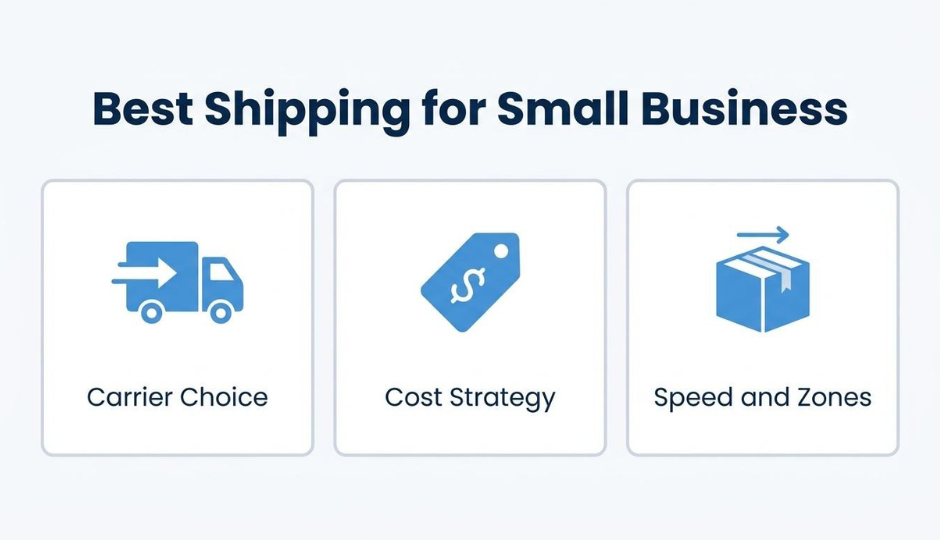
The best shipping options for small businesses are the carrier services, pricing strategies, and fulfillment methods that align with each brand's product type, order volume, and customer expectations. No single option works universally; the right setup depends on what you sell, where you ship, and how fast buyers need it.
This guide covers shipping methods and carrier selection, cost benchmarks and discount strategies, zone optimization and policy setup, returns and packaging, international fulfillment, and scaling beyond a multi-tool workflow.
Small businesses typically use a mix of shipping pricing models (flat rate, free, or carrier-calculated rates), service levels (standard, expedited, next-day, or same-day delivery), and fulfillment methods such as local delivery or freight shipping depending on package size and destination. Each suits different product profiles, and pairing the right method with the right carrier (typically USPS for lightweight parcels, UPS and FedEx for heavier shipments, DHL for international) matters.
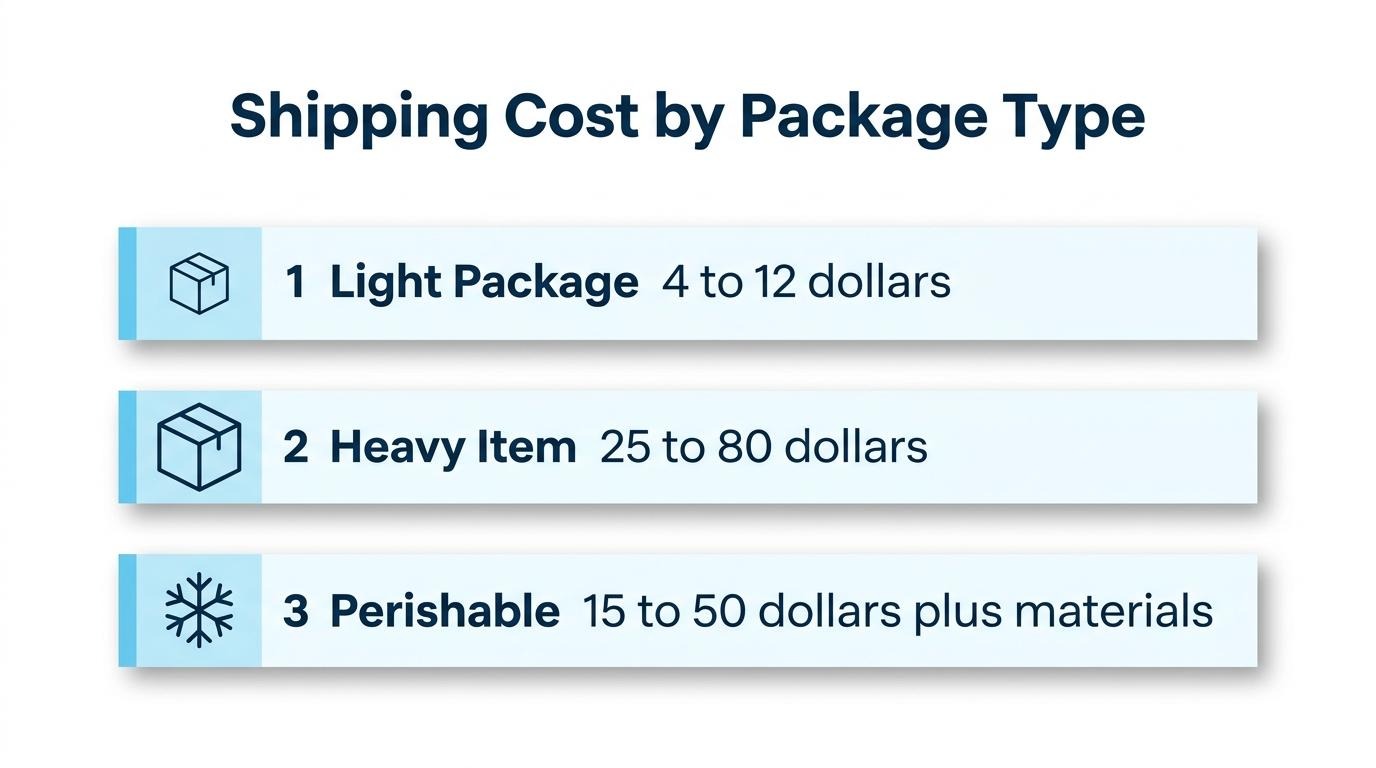
Shipping costs vary widely by package type. Lightweight parcels can ship for as little as $4 cross-country through USPS, while heavy or perishable goods push costs significantly higher. Third-party platforms, volume discounts, and prepaid label purchasing each offer paths to lower per-shipment rates.
Zone-based pricing and delivery speed are directly linked; nearby zones deliver in one to two days at lower cost, while distant zones multiply both price and transit time. Right-sizing packaging, understanding dimensional weight, and positioning inventory closer to customers are the most effective levers for controlling these variables.
Returns add a costly second leg to every order's journey, but structured reverse logistics can recover meaningful revenue. Clear shipping policies reduce cart abandonment and support volume. For brands outgrowing disconnected tools, consolidating fulfillment into a unified commerce platform eliminates sync failures and lowers operational overhead as order complexity grows.
Small businesses can choose from a mix of shipping pricing models, service levels, and fulfillment options such as flat rate, free, carrier-calculated, standard or economy, local delivery, international, expedited, next-day (overnight), ship from store, and freight shipping methods. Each method suits different product types, order values, and customer expectations.
Flat-rate shipping is a method where cost depends on box or envelope size rather than dimensional weight. This predictability simplifies pricing for both the seller and the buyer, since the rate stays fixed regardless of how heavy the contents are.
Lighter items that fill a box benefit most from flat rate, while heavier shipments in smaller packaging may cost less through weight-based alternatives. For small businesses shipping products of consistent size, flat rate removes the guesswork from checkout pricing and reduces cost estimation errors during fulfillment.
Free shipping is a pricing strategy where the business absorbs delivery costs to remove purchase friction. According to Capital One Shopping research, 81% of Americans will spend more to meet a free shipping threshold, and 62% of consumers abandon purchases when shipping is not free.
Most small businesses fund free shipping through one of these approaches:
For brands with healthy margins, free shipping consistently drives higher conversion rates and larger orders.
Real-time carrier-calculated shipping automatically generates rates based on package weight, dimensions, and destination at checkout. Customers see exact costs from carriers before completing their order, which builds pricing transparency.
This method works well for businesses selling products that vary widely in size and weight. Rather than overcharging lightweight orders or undercharging heavy ones, calculated rates match the actual shipping cost to each transaction. The trade-off is that some customers may encounter unexpectedly high rates for distant destinations, potentially increasing cart abandonment.
Local delivery and in-store pickup are fulfillment methods that bypass traditional carrier networks entirely. Businesses deliver orders directly within a defined radius or allow customers to collect purchases at a physical location.
Key advantages include:
These options suit businesses with a strong local customer base, perishable products, or items too fragile for standard parcel handling.
Expedited shipping is a premium service that accelerates delivery times, typically ensuring packages arrive within one to three business days. Overnight shipping compresses that window further to next-business-day delivery.
Both options carry higher per-package costs, so they work best as add-on choices at checkout rather than default methods. Customers purchasing time-sensitive gifts, replacement parts, or perishable goods often expect an expedited tier. Offering faster options without forcing them on every order lets small businesses capture urgency-driven revenue while keeping base shipping affordable.
Freight and LTL (Less Than Truckload) shipping are transportation methods designed for shipments too large or heavy for standard parcel carriers. LTL shipping consolidates multiple shippers' freight onto a single truck, so businesses pay only for the trailer space their goods occupy.
This method suits businesses selling furniture, bulk wholesale orders, or equipment exceeding 150 pounds. Freight carriers price by freight class, which factors in density, handling requirements, and liability. Small businesses new to freight should request quotes from multiple carriers, since rates vary significantly based on origin, destination, and shipment dimensions.
With shipping methods selected, the next step is choosing which carriers best fit each approach.
The best shipping carriers for small businesses depend on package size, destination, and delivery speed. Below, each major carrier's strengths are broken down across USPS, UPS, FedEx, DHL, and regional options.
USPS works for small business shipping by offering the most affordable rates for lightweight parcels through services like First Class Package Service and Priority Mail. According to a 2025 Pitney Bowes rate comparison, USPS continues to offer the lowest rates for small and lightweight parcels, while UPS and FedEx tend to match each other closely on heavier shipments but add fuel, residential, and peak surcharges.
USPS key advantages for small businesses include:
For businesses shipping lightweight, direct-to-consumer orders, USPS is typically the most cost-effective starting point.
UPS works for small business shipping by providing reliable ground and express services with strong tracking infrastructure. UPS Ground delivers within one to five business days domestically, making it a solid mid-tier option between economy and express.
Key characteristics of UPS for small businesses include:
UPS is strongest when shipment weight exceeds one pound and delivery reliability matters more than rock-bottom pricing.
FedEx works for small business shipping by specializing in express delivery and offering scalable solutions through FedEx Ground and FedEx SmartPost. Overnight and two-day services remain core strengths.
FedEx advantages worth evaluating include:
Like UPS, FedEx applies fuel surcharges and peak-season adjustments. Businesses shipping heavier parcels or needing express options often find FedEx and UPS priced within a few dollars of each other.
DHL works for small business shipping primarily through international express services. DHL Express operates the largest global logistics network, covering over 220 countries and territories.
DHL strengths for small businesses include:
For businesses expanding into international markets, DHL excels in this category.
Regional carriers offer small businesses faster last-mile delivery and lower surcharges within specific geographic zones. According to a 2025 Carriyo analysis, 89% of retailers now use alternative carriers alongside national providers, noting that the U.S. e-commerce logistics market has reached $141 billion.
Notable regional carrier benefits include:
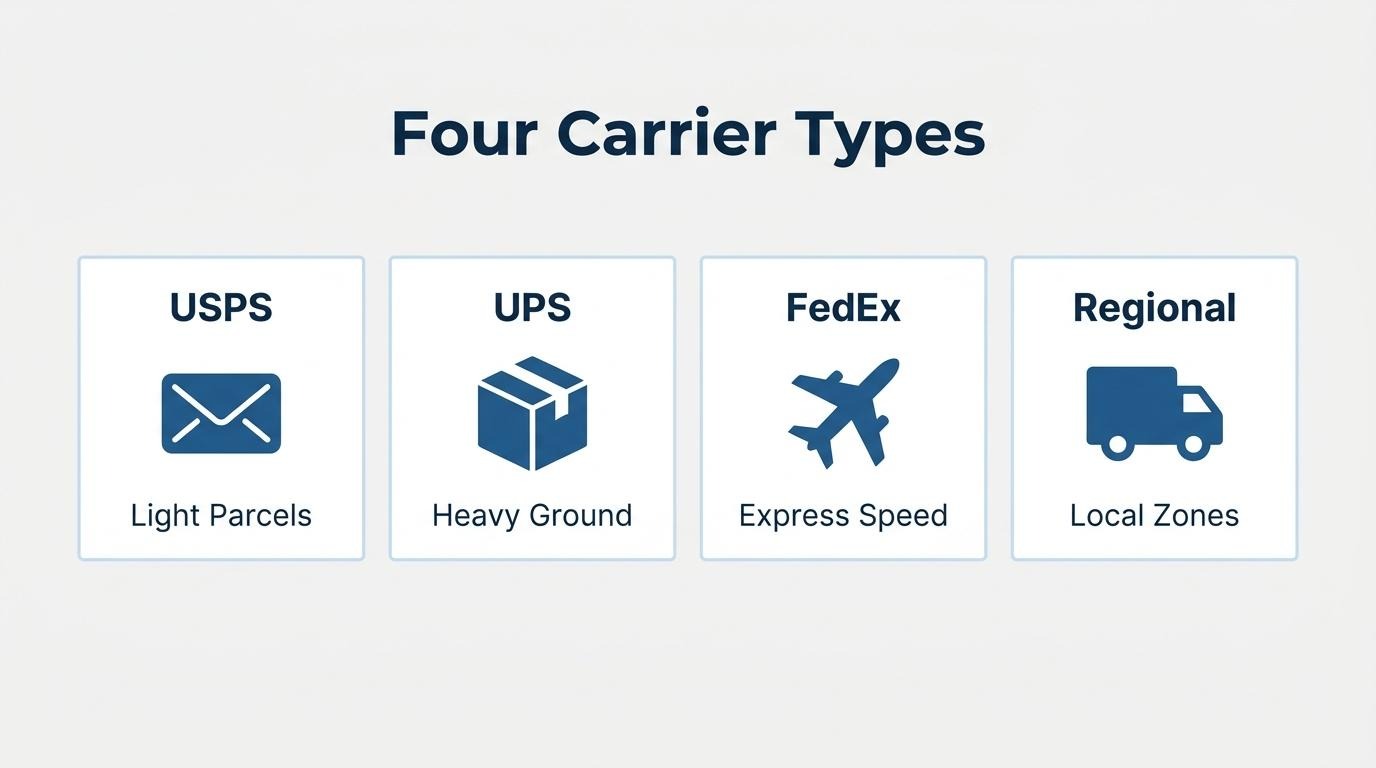
A multi-carrier strategy that pairs national carriers with regional options often yields a strong balance of cost and speed. With carrier selection in place, the next step is understanding how shipping costs break down by package type.
Shipping costs for a small business depend on package weight, dimensions, product type, and destination zone. According to McKinsey & Company, 90% of consumers are likely to abandon shopping carts that feature high shipping costs for standard items. Absorbing part of the cost through minimum-order thresholds for free shipping or offering regional flat rates can help reduce that abandonment risk without erasing margins entirely. Below, each sub-section breaks down costs for lightweight packages, heavy or oversized items, perishable goods, and subscription boxes.
Shipping costs for lightweight packages typically range from around $4 to $12, depending on the carrier and distance. USPS First Class Package Service runs around $4 to $5 for a 12-ounce package shipped cross-country, while UPS and FedEx start around $9 to $12 for a comparable delivery, according to a 2025 GoBolt carrier comparison. For items under one pound, USPS consistently offers the lowest rates. Choosing right-sized packaging and purchasing prepaid labels through a shipping platform can shave additional costs. Lightweight item sellers who compare carrier rates before can avoid overpaying, as small differences in shipping costs can meaningfully impact margins.
Shipping costs for heavy or oversized items rise sharply because carriers apply dimensional weight pricing, surcharges, and zone-based rate tiers. A 30-pound package shipped across several zones can cost $25 to $80 or more through standard ground services. LTL freight becomes cost-effective when individual parcel rates exceed freight consolidation pricing, usually around 150 pounds or multiple large boxes.
Shipping costs for perishable goods are higher than standard packages because they require specialized packaging and faster transit. Insulated liners, gel packs, and dry ice add $3 to $10 per shipment in material costs alone. Expedited two-day or overnight services, which typically run $15 to $50 or more depending on weight and distance, are often necessary to maintain cold chain integrity. Shipping zone selection matters even more here; nearby zones can keep transit under two days with ground service, while distant zones force upgrades to express tiers. Batching shipments early in the week avoids weekend warehouse holds and reduces spoilage risk.
Shipping costs for subscription boxes generally fall between $5 and $15 per box for domestic ground delivery, depending on weight and box dimensions. Because subscription businesses ship the same package configuration repeatedly, they benefit from negotiating volume-based carrier discounts and locking in flat-rate pricing. Consistency in box size also simplifies dimensional weight calculations, which prevents surprise surcharges. Prepaid label purchasing in bulk through third-party shipping platforms further reduc
es per-unit costs. For subscription brands scaling past a few hundred shipments monthly, even a $1 per-box savings compounds into meaningful margin recovery over a full year.
With cost benchmarks established across product types, the next step is securing discounted rates.
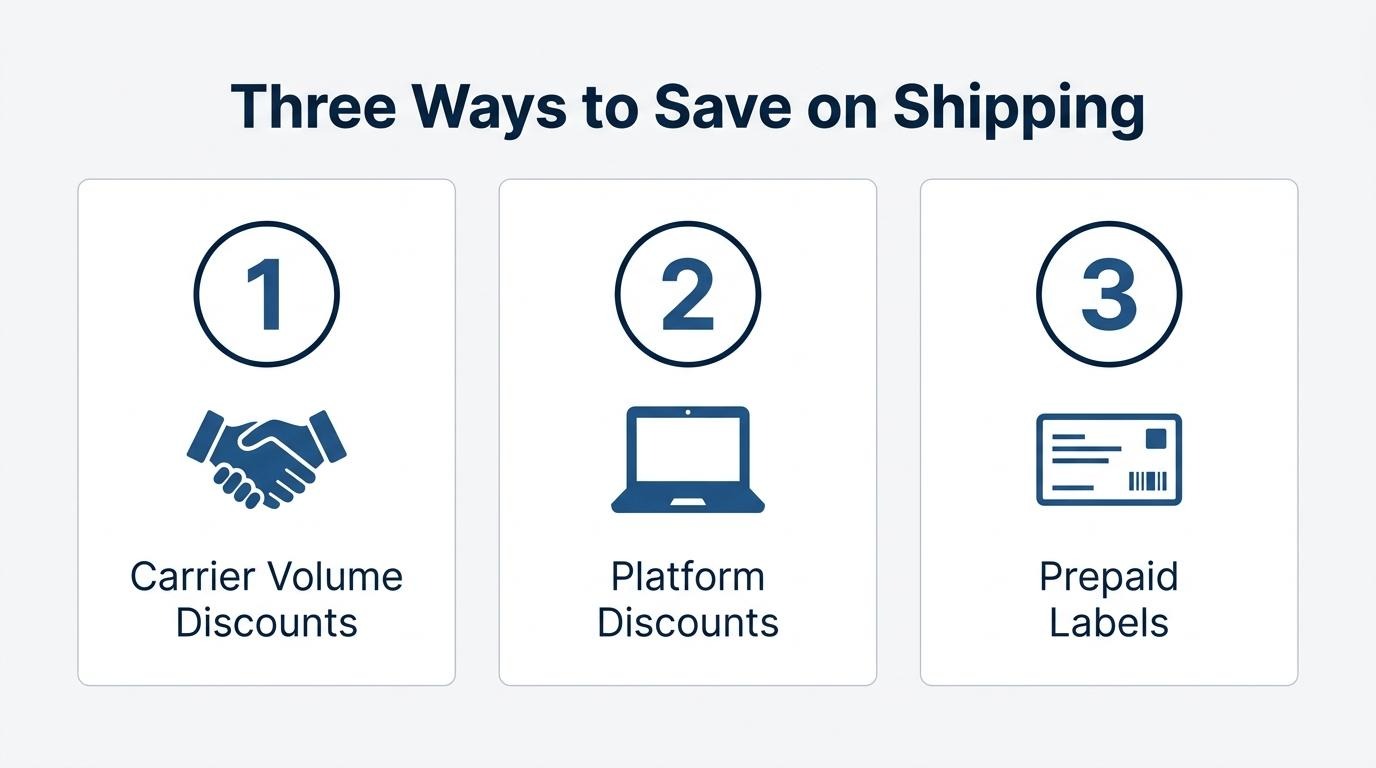
Small businesses can get discounted shipping rates through carrier volume commitments, third-party shipping platforms, and prepaid label purchasing. Each approach unlocks savings differently depending on order volume and fulfillment setup.
Carrier volume discounts work by rewarding businesses that ship consistently high package volumes with reduced per-shipment rates. Major carriers like USPS, UPS, and FedEx each offer tiered pricing programs where the cost per package drops as monthly or annual shipment counts increase. Businesses typically negotiate these rates directly with a carrier sales representative after demonstrating steady volume over several months.
The discount tiers vary by carrier, package weight, and destination zone. For most small businesses, reaching the minimum thresholds can be challenging early on, which makes combining volume discounts with other cost-reduction strategies essential.
Third-party shipping platforms reduce costs by aggregating shipment volume from thousands of merchants and passing pre-negotiated carrier discounts to each seller. These platforms act as intermediaries, giving small businesses access to rates normally reserved for high-volume shippers.
According to a study by the Shipping Institute, shipping costs can be reduced by up to 20% by optimizing package weight, dimensions, and destination. Third-party platforms automate this optimization by comparing rates across carriers in real time and selecting the most cost-effective option for each order.
Prepaid shipping label purchasing lowers rates by letting businesses buy labels in bulk at discounted prices before packages are ready to ship. Carriers and shipping platforms offer these labels at rates below standard counter or on-demand pricing because prepaid purchases guarantee revenue upfront.
This approach works especially well for businesses with predictable order volumes and consistent package sizes. Prepaid shipping labels reduce the need to visit carrier locations and streamline fulfillment
by automating label generation and reducing manual data entry in the shipping workflow, reducing both cost and processing time per order.
With discounted rates secured, the next step is understanding how shipping zones and delivery speed shape your total fulfillment costs.
The best way to handle shipping zones and speed is to understand how zone-based pricing works and position inventory to minimize transit distance. Shipping zones, delivery speed, and strategic fulfillment placement all determine final cost and customer satisfaction.
USPS assigns shipping zones from 1 to 9 based on the straight-line distance between origin and destination ZIP codes. Each zone increase raises both cost and transit time. According to Pitney Bowes, shipping to nearby zones (1–3) usually results in one- to two-day delivery windows, while zones 7–9 may take around four to six days.
This zone-speed relationship creates a direct trade-off for small businesses: serving customers in distant zones means higher rates and longer waits unless fulfillment locations are adjusted.
Strategies to optimize across zones and speed include:
For most small businesses beginning to scale, a high-impact move is locating fulfillment closer to where large majorities of orders ship. Even moving from
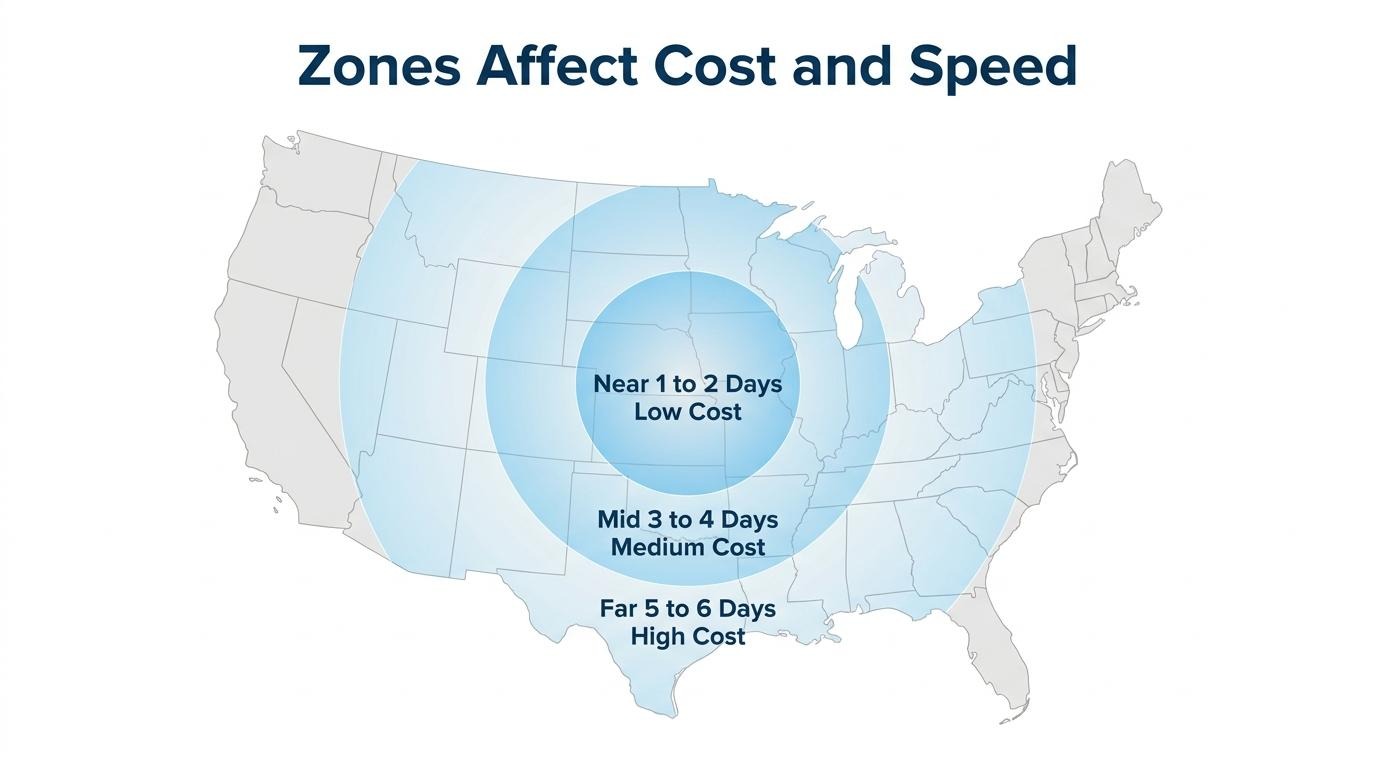
a single coastal warehouse to a centrally located one can drop the average zone by two or three levels, cutting both cost and transit time substantially.
With zone strategy mapped out, a clear shipping policy ensures customers know exactly what to expect before they buy.
Small businesses should set up a shipping policy by clearly defining shipping methods, costs, delivery timelines, and return procedures in one accessible page. The key elements include carrier options, pricing transparency, geographic coverage, and handling times.
A well-structured shipping policy reduces customer service inquiries and sets accurate delivery expectations. When shoppers understand exactly what they will pay and when orders should arrive, purchase hesitation drops significantly. Every shipping policy should cover these core components:
For most small businesses, placing the shipping policy in the website footer and linking it from the checkout page ensures visibility at the moment it matters most. Revisiting the policy quarterly helps account for carrier rate changes, new service additions, or seasonal adjustments.
With a clear shipping policy established, handling the inevitable returns becomes the next operational challenge to address.
Returns and reverse logistics affect shipping by adding a second, often costlier, leg to every order's journey. Managing this reverse flow well reduces expenses and protects margins, while poor handling erodes both.
Online return rates remain high. According to the National Retail Federation's 2025 research, an estimated 19.3% of online sales are expected to be returned that year, with total retail returns projected to reach $849.9 billion. Apparel categories can run among the highest, with rates between 30% and 40%.
Each return triggers costs that mirror or exceed the original shipment:
Retailers that optimize their reverse logistics process can reduce overall logistics costs by up to 50% and recover around 12% of revenue, according to nShift. That recovery gap between well-managed and neglected return operations is one of the largest controllable cost levers a small business has.
For most small businesses, the smartest first step is not eliminating returns but structuring them: clear return windows, prepaid label options at negotiated rates, and restocking workflows that get items back into inventory fast. A return that takes two weeks to process costs far more than one resolved in three days.
With return costs under control, the right packaging strategy can prevent many returns from happening in the first place.
Packaging plays a direct role in shipping costs by influencing both the actual weight and the dimensional (DIM) weight carriers use to calculate rates. Optimizing box size, material weight, and void fill can meaningfully reduce per-shipment expenses.
Carriers price shipments based on whichever is greater: actual weight or dimensional weight. Dimensional weight is calculated by multiplying a package's length, width, and height, then dividing by a carrier-specific divisor. An oversized box with excessive void fill inflates DIM weight, triggering higher charges even when the product inside is light.
Choosing the smallest box that safely protects the item is the most effective way to lower costs. Right-sizing reduces both dimensional weight and the amount of packing material required. Poly mailers work well for soft, non-fragile goods, while corrugated boxes remain necessary for heavier or breakable products. According to Pitney Bowes, shipping costs can be reduced by up to 20% by optimizing package weight, dimensions, and destination.
Material choice matters beyond size. Lightweight corrugated board, recycled kraft paper, and air pillows weigh less than traditional packing peanuts or double-walled cardboard, trimming actual weight without sacrificing protection. For small businesses shipping dozens or hundreds of orders daily, even a few ounces saved per package compounds into significant carrier savings over a billing cycle.
Branded packaging adds perceived value but introduces trade-offs. Custom inserts, tissue paper, and rigid boxes can increase weight and dimensions. Balancing unboxing experience against shipping economics is essential; reserving premium packaging for high-margin products keeps costs proportional to revenue.
With packaging optimized, international shipping introduces additional cost variables worth understanding.
International shipping works for small businesses by coordinating carriers, customs documentation, and duties compliance to move products across borders. The subsections below cover customs and duties rules, carrier options, and destination-based shipping times.
Customs and duties rules that apply to small businesses require accurate product classification, proper documentation, and compliance with destination-country import regulations. Every international shipment needs a commercial invoice listing the item description, declared value, country of origin, and Harmonized System (HS) code.
As of August 29, 2025, the United States suspended duty-free de minimis treatment, according to Zonos, meaning imports of any value are now subject to duties and tariffs. Small businesses shipping internationally must decide whether duties are paid by the seller (Delivered Duty Paid) or the buyer (Delivered Duty Unpaid/Delivered at Place). Choosing the wrong structure can lead to refused deliveries and unexpected costs that erode margins on cross-border orders.
The carriers that handle international small business shipments include USPS, UPS, FedEx, and DHL Express, along with local carriers in the country the package is shipped to. Each offers distinct advantages depending on package weight, destination, and speed requirements.
According to Shipink, international shipments typically take 3 to 15 business days depending on destination and service level. Matching the right carrier to each corridor keeps costs predictable and delivery promises realistic.
Shipping times vary by international destination based on distance, customs processing speed, and carrier service tier. Nearby markets like Canada and Mexico typically see delivery within 3 to 7 business days through standard services, while shipments to Europe average 5 to 10 business days or longer. Destinations in Asia-Pacific, South America, and Africa often require 10 to 15 business days or longer due to longer transit routes and more complex customs clearance.
Expedited services can compress these windows significantly, though at higher cost. Remote or landlocked regions may add further delays beyond carrier estimates. For small businesses selling internationally, setting accurate delivery expectations at checkout reduces customer complaints and builds trust across borders.
Small businesses track and communicate shipments by using order tracking pages, automated email or SMS notifications, and carrier-provided tracking numbers that customers can follow in real time.
Real-time shipment status updates improve customer loyalty. According to a 2025 Sifted consumer survey, 76% of shoppers said a positive delivery experience influenced their decision to repurchase from a brand. This makes proactive shipping communication one of the highest-leverage retention tools available to small merchants.
Effective shipment tracking and communication typically involve:
For growing brands, the gap between shipping data and customer communication often widens as order volume increases. Manually copying tracking numbers into emails breaks down quickly. Platforms that connect shipping label generation directly to customer-facing notifications eliminate that manual step and keep buyers informed without additional staff effort. As order complexity grows, consolidating these workflows becomes a strategic priority.
Shipping strategy changes when orders outgrow a multi-tool setup by shifting from stitched-together apps toward a single platform that can handle fulfillment, tracking, and carrier management components in one place. The sections below cover what unified commerce changes and the key takeaways for small business shipping.
What changes when shipping tools live inside a unified commerce platform like SHOPLINE is that order routing, carrier selection, inventory, and post-purchase communication operate from one system instead of requiring separate tools synced through integrations. This helps unify the data gaps that can appear between separate platforms such as shipping apps, storefronts, and CRMs.
According to a 2024 Bleckmann whitepaper on unified commerce, companies using unified commerce platforms can achieve implementation speeds up to 20% faster and a 22% improvement in cost of ownership compared with fragmented omnichannel systems. For brands processing hundreds of daily orders, that consolidation translates into fewer sync failures, faster label generation, and consistent tracking updates requiring significantly less manual reconciliation across platforms.
SHOPLINE is one option for brands consolidating shipping, CRM, and storefront operations into a single system rather than managing separate tool stacks.
The key takeaways about shipping options for small businesses center on matching carrier selection, pricing strategy, and fulfillment workflows to actual order volume and product characteristics. The most actionable lessons from this guide include:
Choosing the right shipping setup is not a one-time decision; revisiting carrier contracts, packaging dimensions, and fulfillment workflows quarterly keeps costs aligned with growth.