.png)
DAP (Delivered at Place) is an Incoterm where the seller arranges and pays for transportation to a named destination, while the buyer handles import customs clearance, duties, taxes, and unloading upon arrival.
This guide covers how DAP works relative to other Incoterms, its operational advantages for cross-border sellers, the customer experience and compliance risks it introduces, when to choose DAP over DDP, and how to implement DAP effectively in an ecommerce store.
Under DAP, sellers retain full control over carrier selection, routing, and export documentation without needing tax registrations or customs expertise in each destination country. This consistent obligation structure lets merchants test new markets and scale internationally with lower upfront costs and less compliance overhead.
The tradeoff sits squarely on the buyer's side. Customers who encounter unexpected duties at delivery often refuse packages, leave negative reviews, or abandon future purchases. Pricing transparency suffers because the checkout total under DAP never reflects the true landed cost, and hidden expenses like demurrage fees, return logistics, and increased support volume can erode margins faster than the duty savings justify.
Choosing between DAP and DDP depends on order value, customer price sensitivity, and market maturity. DAP fits high-value orders and low-volume corridors where prepaying duties is impractical; DDP serves price-sensitive consumers who expect an all-in checkout total.
Setting up DAP successfully requires clear checkout disclosures, real-time duty estimation tools, and a unified system that connects shipping rules to customer data so cost calculations stay accurate across every market.
DAP (Delivered at Place) is an Incoterm where the seller arranges and pays for transportation to a named destination, but the buyer handles import customs clearance, duties, taxes, and unloading. According to the ICC Academy, under DAP the seller delivers goods and transfers risk to the buyer once the shipment arrives at the agreed destination ready for unloading, while the buyer is responsible for handling and paying for the entire import clearance process. This division of responsibility makes DAP one of the most commonly used terms in cross-border ecommerce, since sellers retain control over transit logistics without taking on the complexity of destination-country customs compliance. The sections below break down how DAP compares to other Incoterms, where it benefits ecommerce sellers, and where it introduces risk.
DAP differs from other Incoterms in how it allocates transport costs, customs duties, and risk transfer between buyer and seller. The key comparisons involve DDP, EXW, CIF, and FOB.
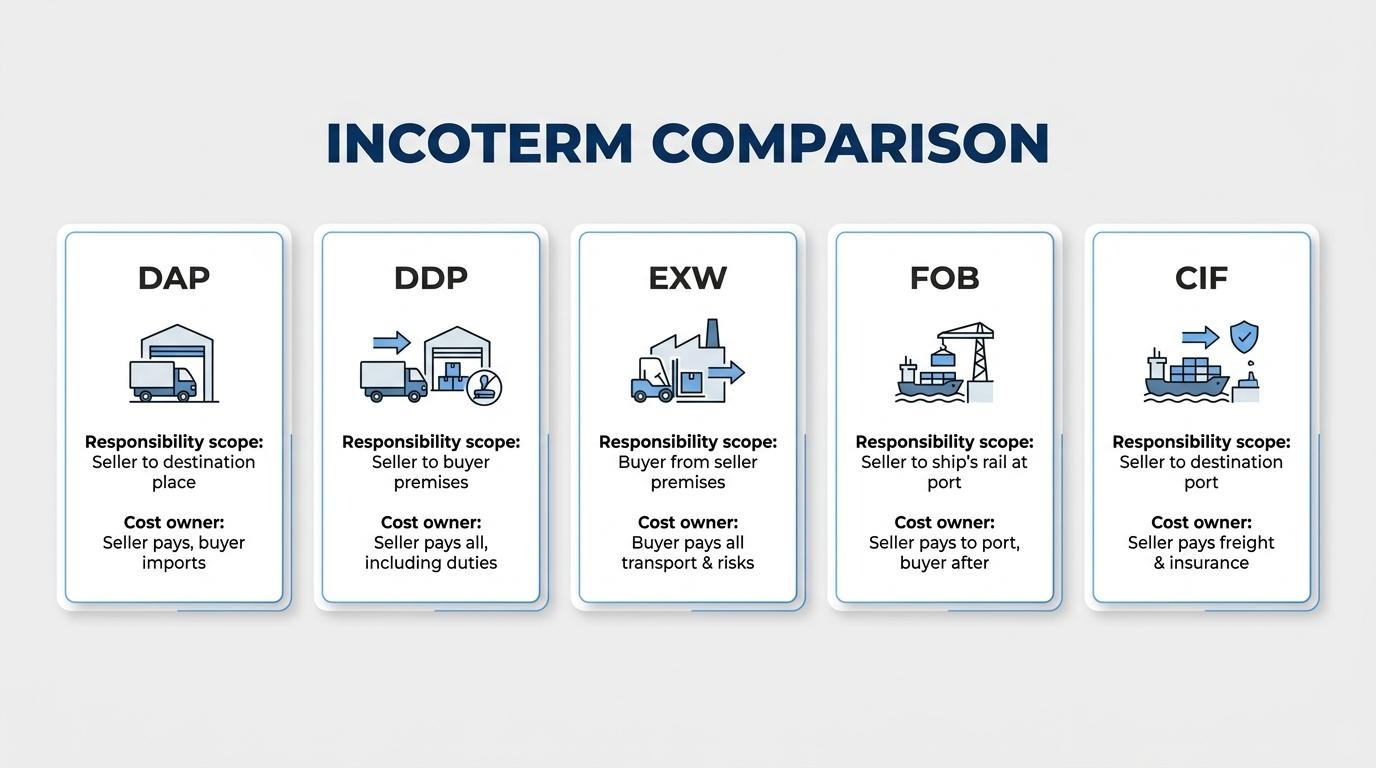
DAP compares to DDP primarily in who pays import duties and taxes. Under DAP, the seller arranges transport and handles export declarations, but the buyer pays duties and taxes upon arrival. Under DDP (Delivered Duty Paid), the seller covers all duties and taxes before the parcel reaches the customer. According to the International Trade Administration, Incoterms specify who is responsible for paying for and managing shipment, insurance, documentation, customs clearance, and other logistical activities in international transactions.
For ecommerce sellers, this distinction directly shapes the buyer's checkout experience. DDP eliminates surprise charges at delivery; DAP shifts that financial responsibility to the customer.
DAP compares to EXW (Ex Works) as nearly opposite ends of the seller's obligation spectrum. Under EXW, the seller's responsibility ends the moment goods are available at their premises. The buyer arranges all transport, export clearance, and import clearance from that point forward.
DAP reverses most of that burden. The seller manages transport and export documentation all the way to the buyer's named destination. Only import customs clearance and duties remain with the buyer. For ecommerce merchants shipping internationally, EXW offers the least control over delivery timelines, while DAP provides far greater logistics oversight without requiring the seller to navigate destination-country import procedures.
DAP compares to CIF and FOB in risk transfer point and transport scope. The differences include:
Both CIF and FOB apply only to sea and inland waterway transport. DAP works across any transport mode, including air, road, and rail, making it more versatile for ecommerce fulfillment.
With these Incoterm distinctions clear, the next step is evaluating DAP's specific advantages for online sellers.
The pros of DAP shipping for ecommerce sellers include lower upfront costs, simplified customs obligations, greater logistics control, and easier market expansion. Each advantage addresses a specific operational challenge cross-border merchants face.
DAP reduces upfront shipping costs for sellers by shifting import duties, taxes, and customs fees to the buyer at destination. This structure keeps the seller's per-order expense predictable, limited to transport and export handling.
For merchants testing international demand, this cost separation prevents large, variable duty payments from straining cash flow before revenue scales. Sellers price products without baking in destination-country tariffs, which keeps listed prices competitive against local alternatives. For brands entering multiple countries simultaneously, avoiding prepaid duties across different tax regimes can meaningfully reduce working capital requirements.
DAP simplifies customs responsibilities for merchants because the buyer handles all import clearance obligations. According to Avalara, under DAP the seller delivers goods to the buyer but does not cover import duties, taxes, or customs clearance; the buyer is responsible for import customs clearance, import VAT or GST, and unloading at the agreed final destination.
This separation means sellers avoid navigating each destination country's unique import regulations, tariff classifications, and tax registration requirements. Merchants can focus operational resources on export compliance and transport coordination rather than maintaining expertise across dozens of import regimes.
DAP gives sellers more control over delivery logistics by making them responsible for arranging transport from origin to the named destination. The seller selects carriers, negotiates freight rates, and determines routing.
This control allows merchants to optimize for speed, cost, or reliability based on customer expectations. According to Miller Johnson, unlike CIP where sellers must procure cargo insurance complying with Institute Cargo Clauses (A), DAP imposes no obligation to contract for coverage insurance. Sellers can choose whether to insure shipments based on order value and risk tolerance rather than contractual mandate, keeping logistics decisions flexible.
DAP is easier to scale across multiple markets because it applies a consistent seller obligation regardless of destination country. The seller's responsibility ends at the same point for every market: goods delivered to the agreed place, ready for unloading.
Since buyers handle local import procedures, sellers avoid the complexity of registering for import duties or tax accounts in each new country. Expanding from one international market to five requires no additional customs infrastructure on the seller's side. The uniform structure lets merchants test demand in new regions without committing to country-specific compliance setups upfront.
Understanding these advantages helps clarify where DAP falls short, which the next section examines.
The cons of DAP shipping for ecommerce sellers center on buyer-side cost surprises, delivery failures, and margin erosion. These drawbacks span unexpected duties, shipment refusals, opaque pricing, and hidden operational costs.
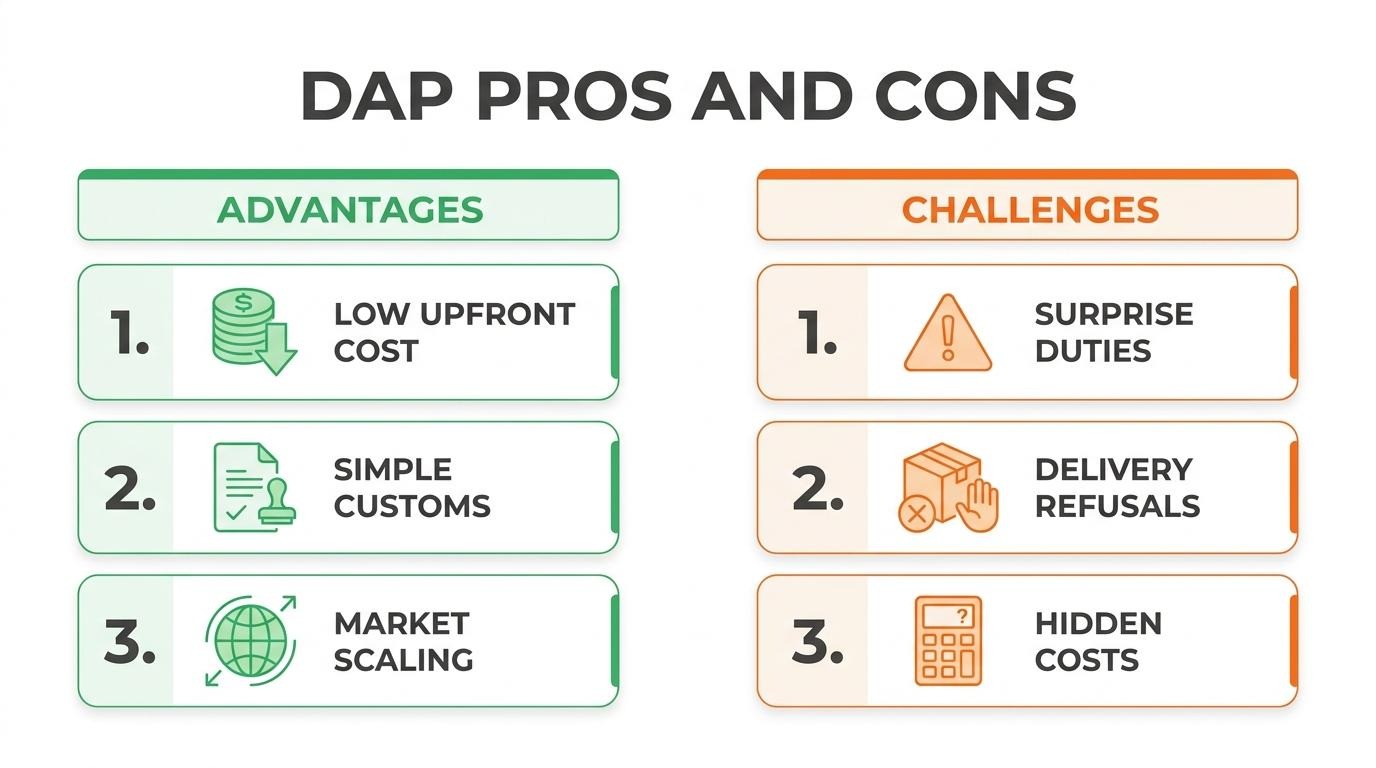
Unexpected duties hurt customer experience by creating unplanned costs that buyers must pay before receiving their order. Under DAP terms, the seller arranges transport and handles export declarations, but the buyer pays duties and taxes upon arrival, according to Landmark Global. This means a customer who saw one price at checkout faces a second, unquoted charge at delivery.
That gap between expected and actual cost triggers frustration, negative reviews, and lost trust. For brands selling cross-border, even a modest customs charge can feel like a bait-and-switch when it arrives without warning. Proactive duty estimation at checkout reduces this friction, though it cannot eliminate it entirely under DAP.
DAP shipments risk delivery refusals and returns because buyers who encounter surprise import fees may simply decline the package. When a customs broker or carrier demands payment before releasing goods, some customers refuse rather than pay.
A refused shipment creates a cascade of problems for the seller:
For scaling ecommerce operations, even a small refusal rate compounds quickly across hundreds of international orders per month.
DAP creates pricing transparency challenges because the final landed cost remains unknown to the buyer until delivery. Duty rates vary by product classification, country of import, and trade agreements, so the checkout price under DAP reflects only the product and shipping cost, not the total amount owed.
This incomplete pricing undermines trust. Buyers comparing options across stores may choose a competitor offering DDP with a clear all-in price. For merchants, the inability to display a definitive total at checkout weakens conversion rates and complicates international pricing strategy. Transparency is now a baseline expectation in cross-border ecommerce, and DAP inherently works against it.
Hidden costs that erode margins under DAP terms include demurrage fees, return logistics, customer service overhead, and refund processing. According to the ICC Academy, under DAP the seller delivers goods to the agreed destination ready for unloading, while the buyer handles and pays for import clearance. If clearance stalls, storage charges accumulate against the seller's margin.
Additional margin risks include:
These costs rarely appear in shipping rate calculations, making DAP margins harder to forecast than they seem on paper. Understanding these risks upfront helps sellers decide when DAP terms genuinely make financial sense.
An ecommerce business should choose DAP over DDP when shifting import duties to the buyer reduces financial risk or operational complexity. The best scenarios include high-value orders, unfamiliar markets, and B2B transactions.
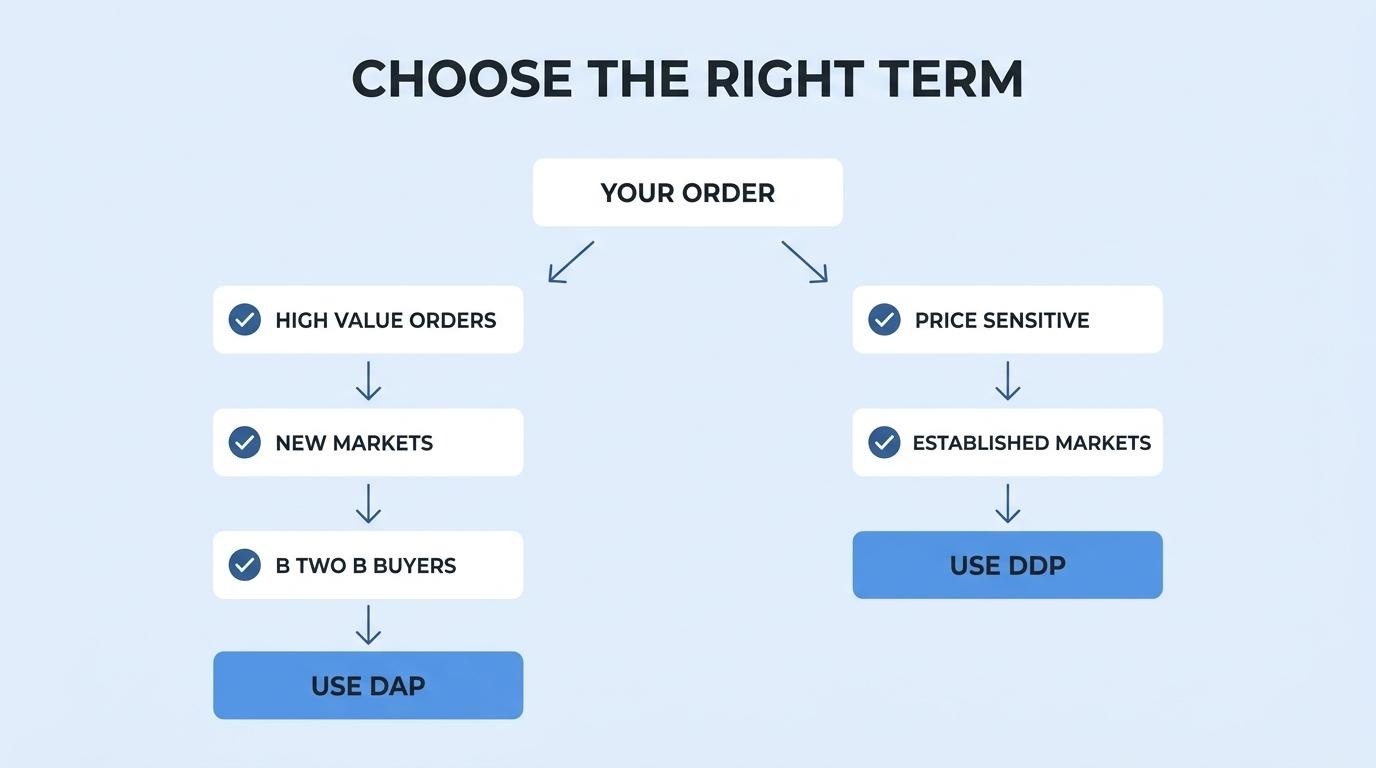
DAP works best for high-value orders when the import duties and taxes would be disproportionately expensive for the seller to prepay. Luxury goods, custom equipment, and large B2B purchases often carry significant duty obligations that vary by destination country. Under DAP, the buyer absorbs these costs at the point of import, which protects seller margins on orders where duty exposure is difficult to predict accurately. B2B buyers, in particular, are accustomed to handling their own customs clearance and often have established broker relationships. For merchants selling high-ticket items across multiple countries, DAP avoids the need to calculate and embed wildly different duty rates into product pricing.
DAP is preferable for new or low-volume markets when the seller lacks the local tax registrations, customs expertise, or order volume to justify DDP infrastructure. Entering a new country under DDP requires understanding local duty rates, VAT or GST obligations, and compliance requirements before the first shipment arrives. DAP lets merchants test demand without that upfront investment. According to the International Trade Administration, Incoterms specify who is responsible for paying for and managing shipment, insurance, documentation, customs clearance, and other logistical activities. Starting with DAP in low-volume corridors keeps operational overhead low while the seller evaluates whether a market warrants the full DDP commitment.
You should avoid DAP for price-sensitive customers when unexpected duties at delivery would likely trigger refusals or negative reviews. Consumers shopping on price expect the number at checkout to be the final cost. Under DAP, a surprise customs bill upon delivery creates friction that erodes trust and increases return rates. This risk is especially acute in direct-to-consumer channels where buyers compare total costs across competing stores. For price-sensitive segments, DDP typically delivers a smoother experience because duties are calculated and collected upfront. Reserving DAP for buyers who understand and accept import responsibilities keeps satisfaction high where cost sensitivity is low.
Understanding when DAP fits your customer profile also shapes how those shipments affect the broader post-purchase experience.
DAP shipping affects the customer experience by shifting import duties, taxes, and customs clearance to the buyer, which can create friction at delivery. The result depends on how well sellers communicate these costs before purchase. Below, the key touchpoints where DAP terms shape buyer satisfaction are broken down: surprise fees at delivery, trust and transparency at checkout, and how post-purchase communication can reduce negative outcomes.
Under DAP terms, the buyer pays duties and taxes upon arrival. When customers encounter unexpected charges they did not anticipate during checkout, frustration follows. According to Landmark Global, the seller arranges transport and handles export declarations under DAP, but the buyer pays duties and taxes upon arrival, whereas under DDP the seller covers all duties and taxes before the parcel reaches the customer. This gap between what customers expect to pay and what they actually owe at the door is where most experience breakdowns occur.
Checkout transparency directly determines whether a DAP order feels acceptable or deceptive to the buyer. Displaying estimated landed costs, including duties and local taxes, before order confirmation sets realistic expectations. Sellers who bury DAP terms in fine print or skip duty estimates entirely risk:
For brands selling internationally at scale, proactive post-purchase communication is often the most underrated lever for protecting customer experience under DAP. Sending order confirmation emails that restate the buyer's customs responsibility, providing tracking with customs status updates, and linking to local duty calculators all reduce the shock factor. Sellers who treat DAP communication as an afterthought tend to see higher return rates and lower repeat purchase rates in cross-border markets. The most effective DAP strategies pair transparent checkout estimates with consistent post-purchase reinforcement, turning a structural disadvantage into a trust-building touchpoint.
Understanding customer-facing friction is one side of DAP; the compliance risks merchants face on the operational side add another layer of complexity.
The customs and compliance risks of DAP shipping stem from the buyer's responsibility for import clearance, duties, and taxes at destination. Shifting regulatory landscapes and inconsistent enforcement across markets compound these risks for ecommerce sellers.
DAP exposes merchants to several interconnected compliance challenges:
For brands shipping across multiple markets, these risks multiply with each new destination. The practical reality is that sellers cannot fully control the buyer's customs experience, yet delivery failures still damage brand perception. Proactive measures like pre-shipment duty calculators, clear checkout disclosures, and accurate HS code classification reduce exposure considerably, even when the formal obligation sits with the buyer.
Understanding how to implement these safeguards at checkout is the next step toward managing DAP effectively.
You set up DAP shipping by configuring checkout transparency, duty estimation tools, and a clear returns policy for international orders. The following sections cover each step.
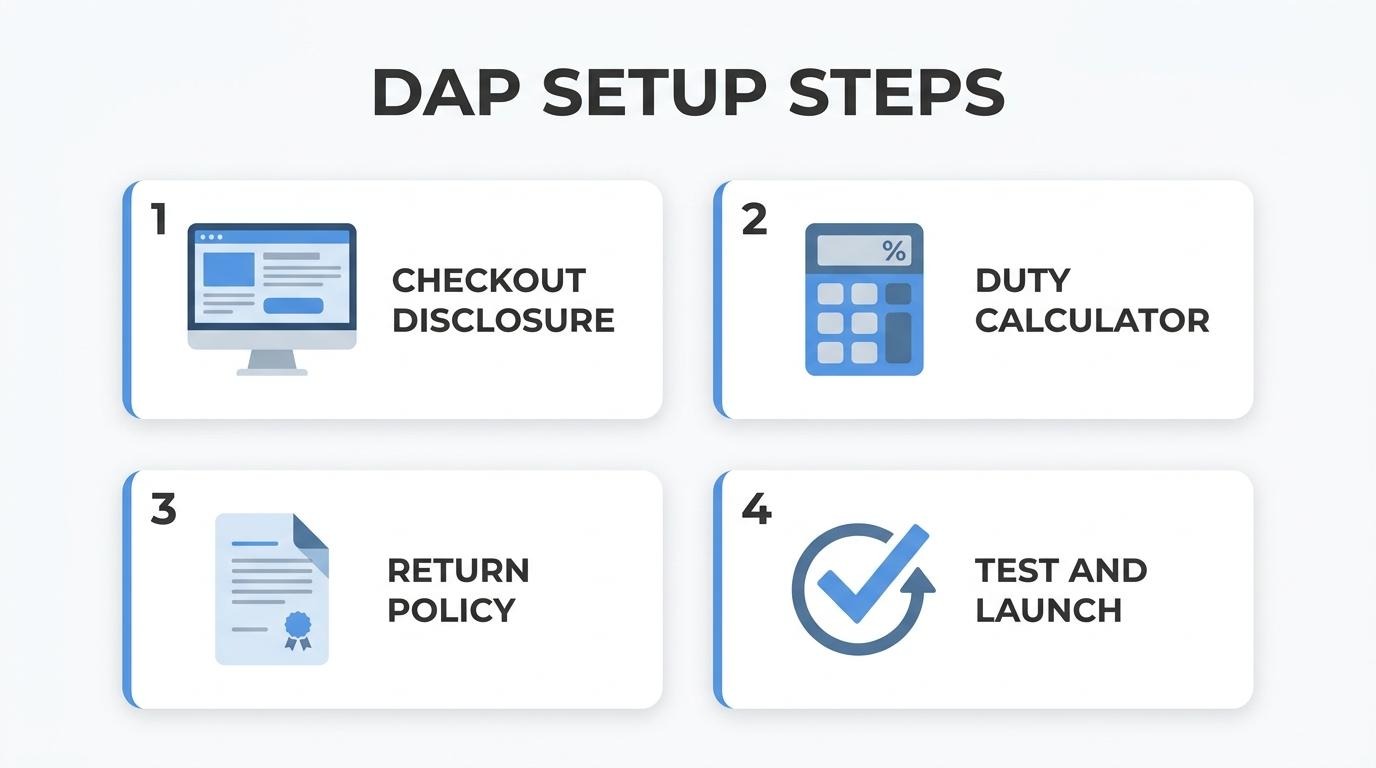
You communicate DAP terms at checkout by displaying clear notices that the buyer will owe import duties, taxes, and customs fees upon delivery. Under DAP, the buyer is responsible for import customs clearance, import VAT or GST, and unloading at the agreed destination.
Effective communication includes:
Vague language causes confusion and refusals. Stating the exact responsibilities upfront, in plain terms, is the single most effective way to reduce delivery disputes on DAP orders.
You calculate estimated duties for DAP orders by using landed cost calculators that apply HS (Harmonized System) codes, destination country tariff rates, and declared product values. These tools pull real-time duty and tax rates so buyers see an estimate before completing their purchase.
Key inputs for accurate calculations include product category, country of origin, destination country, and order value. As of August 2025, the United States suspended duty-free de minimis treatment, according to Zonos, meaning imports of any value are now subject to applicable duties, taxes, and fees.
Displaying estimated duties at checkout does not make the seller liable for the final amount, but it sets realistic expectations that reduce abandoned carts and refused deliveries.
You handle returns on DAP international shipments by establishing a clear, country-specific return policy that addresses who pays return shipping, whether duties are refundable, and how long the process takes.
A practical DAP return workflow covers:
Because DAP shifts customs costs to the buyer, a generous and transparent return policy builds the trust needed to keep international customers ordering again. With returns handled, connecting shipping rules to your broader store operations keeps the process efficient.
Cross-border shipping complexity changes on a unified commerce platform by consolidating shipping rules, customer data, and checkout logic into one system. This eliminates the sync gaps that cause pricing errors and surprise fees at delivery.
When shipping rules and customer data live in one system instead of separate apps, duty estimates, tax calculations, and delivery options pull from the same source of truth at checkout. This matters because unexpected costs drive abandonment at massive scale. According to Baymard Institute data cited by Passport Global, unexpected extra costs, including shipping fees, taxes, and duties, are the most common reason shoppers abandon carts, with roughly 70% of online shopping carts abandoned on average.
Fragmented setups often display shipping costs from one app while a separate tax tool calculates duties independently, creating mismatches that surface only after purchase. A single system ties the customer's shipping address, product classification, and destination-country rules together in real time, so the checkout total reflects actual landed cost. For brands shipping DAP, where the buyer handles import clearance, this transparency becomes especially critical to set accurate expectations before the order confirms.
The key takeaways about DAP shipping for ecommerce businesses center on balancing cost efficiency against customer experience risk.
For scaling brands managing DAP across multiple markets, the operational question is not just which Incoterm to choose, but whether the underlying systems can surface accurate cost information before the customer commits. SHOPLINE is one option for brands looking to run shipping logic, customer records, and checkout within a single system rather than reconciling data across disconnected tools.