Business capital is the collection of financial resources, assets, and intangible value a company uses to fund operations, compete in its market, and pursue growth. It extends well beyond cash to include workforce expertise, intellectual property, and physical infrastructure.
This guide covers the four types of business capital, how each type fuels operations and creates value, capital calculation and structure, and strategic allocation for scaling brands.
Financial capital comprises investments, equity, and debt that companies use to generate revenue. We break down equity financing, debt financing, and retained earnings as distinct funding sources, each carrying different implications for ownership, repayment obligations, and operational flexibility.
Human capital represents the economic value of employee skills, training, and experience. Employer-led training programs, retention strategies, and measurable frameworks like Human Capital Return on Investment all determine whether workforce spending translates into compounding business value or a recurring cost center.
Intellectual capital covers intangible assets such as patents, proprietary processes, brand equity, and customer relationships. For many companies, these assets account for the largest share of total valuation, making them the hardest form of capital for competitors to replicate.
Physical capital includes buildings, machinery, equipment, and technology hardware. Unlike other capital types, these tangible assets depreciate over time, which makes maintenance, modernization, and depreciation planning essential to accurate financial reporting.
We also cover how to calculate total capital needs, the distinction between working capital and total capital, methods for raising additional funding, and how capital structure decisions shape long-term growth for scaling DTC brands.
Business capital means the financial resources, assets, and non-tangible value a company uses to fund operations and pursue growth. According to Investopedia, capital refers to financial resources such as funds or assets that businesses utilize to enhance their operational capabilities and achieve growth objectives. This definition extends well beyond cash in a bank account. Capital encompasses physical equipment, workforce expertise, intellectual property, and liquid funds, all of which enable a company to produce goods and services, compete in its market, and scale over time.
The Federal Reserve Bank of Dallas frames capital as anything that brings ideas and abilities to fruition and enables production of goods and services more efficiently. That broader lens matters because many business owners think of capital strictly as money. In practice, a skilled team, a patented process, or a physical warehouse with inventory inside all represent forms of capital that drive daily operations and long-term positioning. Understanding what business capital actually includes is the first step toward managing it strategically, whether a brand is raising its first round of funding or reallocating resources at scale.
Business capital is important for growing a business because it funds every stage of expansion, from hiring talent to acquiring equipment and sustaining daily operations. Without adequate capital, businesses struggle to scale, compete, or even survive.
Capital fuels product development, market entry, and the operational infrastructure required to handle increasing demand. It also provides the financial cushion needed to absorb setbacks without halting growth. For scaling brands, the question often becomes about liquidity as well as whether the right mix of financial, human, intellectual, and physical capital is being allocated where it drives the most return.
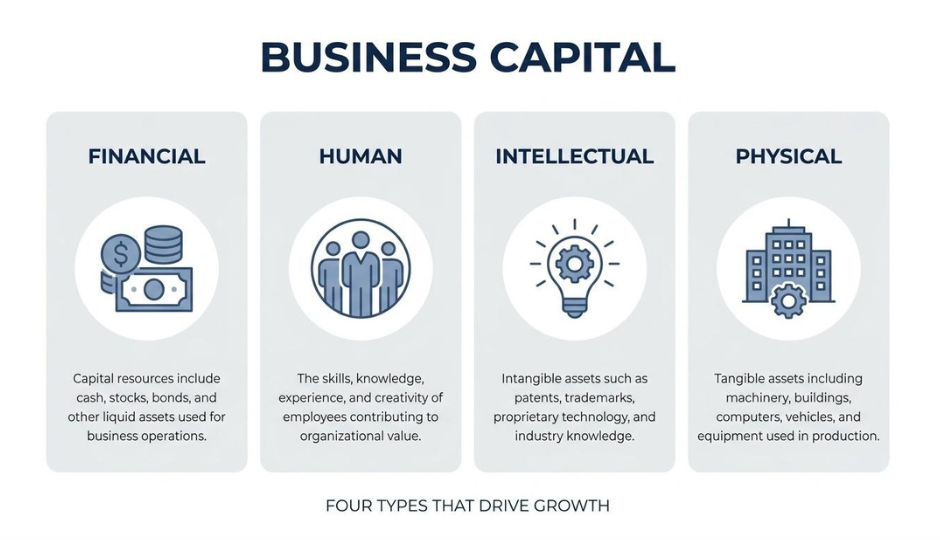
The 4 types of business capital are financial capital, human capital, intellectual capital, and physical capital. Each type contributes differently to a company's ability to operate, compete, and grow.

Financial capital comprises all types of funding that companies use to create wealth. Examples include investments, equity, and debt, all of which help a company generate revenue. This category covers the monetary resources a business holds or can access: cash on hand, credit lines, venture funding, retained profits, and proceeds from selling shares. For most businesses, financial capital is the starting point; without it, acquiring the other three types becomes difficult. However, accumulating funds alone does not guarantee growth. How efficiently a company deploys its financial capital across operations, hiring, and assets ultimately determines whether that money translates into sustainable value.
Human capital is the economic value of a worker's experience and skills. Education, training, intelligence, health, and qualities like loyalty and punctuality all enhance it. According to Investopedia, employer training can contribute to 46% of the average employee's lifetime earnings, which underscores why workforce development is an investment, not just a cost. Businesses measure this investment through Human Capital Return on Investment (HCROI), calculated as (Revenue minus Human Capital Cost) divided by Human Capital Cost. For scaling brands, human capital often becomes the differentiator between stalled growth and operational momentum; skilled, retained employees compound institutional knowledge that financial capital cannot quickly replace.
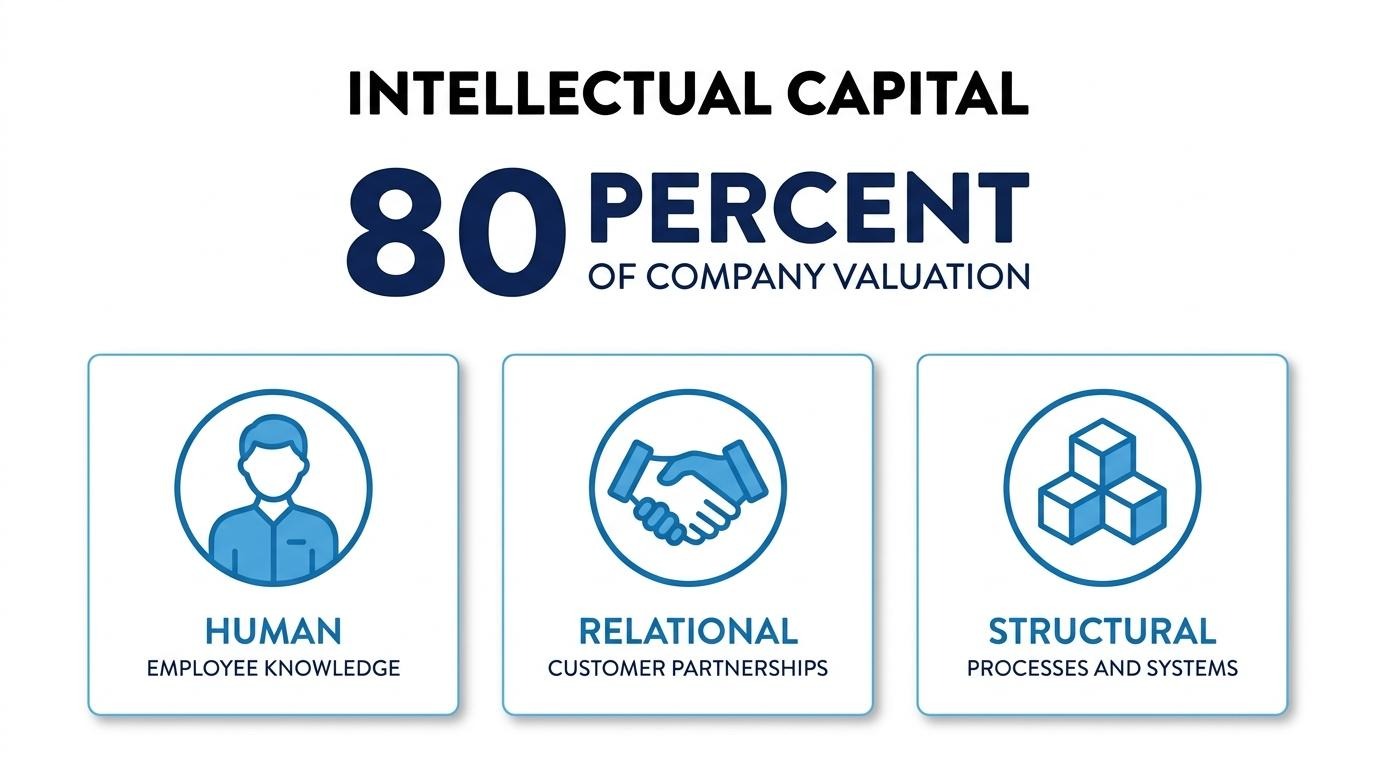
Intellectual capital refers to the intangible assets a company possesses, including its knowledge, skills, relationships, and innovations. According to CalderGR, intellectual capital may account for up to 80% of a company's valuation, since much of that value cannot be held or sold directly. Three categories define it:
For brands investing heavily in customer experience and proprietary processes, intellectual capital is often the hardest asset for competitors to replicate.
Physical capital is the tangible property a company owns, such as buildings, real estate, machinery, tools, and equipment. Unlike financial or intellectual assets, physical capital is subject to economic depreciation: the decline in value of services a capital asset produces due to physical loss, changing demand, or obsolescence. This reality makes maintenance, modernization, and strategic replacement essential. For ecommerce brands, physical capital increasingly includes warehouse infrastructure, fulfillment equipment, and technology hardware. Businesses that neglect depreciation planning often face sudden, large replacement costs that strain cash flow.
With these four types clarified, the next step is understanding how financial capital specifically fuels day-to-day operations.
Financial capital fuels business operations by providing the monetary resources companies need to fund growth, cover expenses, and invest in new opportunities. The three primary sources are equity financing, debt financing, and retained earnings, as well as hybrid structures.

Equity financing is capital raised by selling ownership shares in a company. It can come in several forms; according to Investopedia, distinctions are typically made between private equity, public equity, and real estate equity. Equity financing can include public offerings (IPOs), venture capital firms, and angel investors, all of which provide capital in exchange for ownership stakes or equity-linked instruments. Incubators and accelerators may also support startups during early stages, often providing mentorship, resources, and sometimes small amounts of equity-based or grant-funded financing. Selling shares dilutes existing ownership but brings in capital without creating a repayment obligation. For growing businesses, this trade-off between ownership dilution and debt-free funding is one of the most consequential capital decisions a founder will make. Equity investors share the risk, which can provide more breathing room during periods of aggressive scaling or unpredictable revenue.
Debt financing involves borrowing funds that must be repaid over time, usually with interest. Common forms include:
Unlike equity financing, debt preserves full ownership. However, fixed repayment schedules create obligations regardless of business performance. For operationally stable businesses with predictable cash flow, debt often makes sense because the cost of interest is typically lower than the cost of giving up equity at a high-growth stage.
Retained earnings work as capital by redirecting a portion of a company's profit back into the business instead of distributing it to shareholders. Retained earnings can be leveraged as reinvestment capital for operational growth, R&D, or debt reduction. This makes them a self-generated funding source that carries no dilution and no interest cost. For brands already generating consistent profit, retained earnings represent an efficient path to funding expansion, since the money is already inside the business and available immediately.
Understanding how these three financial capital sources interact sets the stage for examining how human capital creates business value through workforce skills and retention.
Human capital drives business value by converting employee skills, training, and experience into measurable economic output. The sections below cover which skills and training build human capital and how employee retention protects that investment.
The skills and training that build human capital include education, employer-led programs, intelligence development, skillsets, and workplace qualities such as loyalty and punctuality. Human capital represents the economic value of a worker's experience and skills, and these attributes determine how much value each employee generates.
Businesses measure this contribution using Human Capital Return on Investment (HCROI):
According to Investopedia, job skills acquired through employer training can contribute to 46% of the average employee's lifetime earnings. That figure makes structured training programs one of the highest-leverage investments a business can make in its workforce. Companies that treat training as optional rather than strategic often leave significant productivity gains unrealized.

Employee retention directly affects human capital by preserving the accumulated knowledge and experience within an organization. Human capital includes education, life experiences, and work experience; when employees leave, that institutional knowledge exits with them.
Retention also protects relational capital, which encompasses every relationship an organization maintains with employees, suppliers, customers, and shareholders. High turnover disrupts these networks, forcing costly rebuilding of both internal expertise and external partnerships. For scaling brands managing complex operations across multiple channels, losing experienced team members compounds operational friction quickly.
Investing in retention safeguards both the hard skills employees develop and the relationship networks they maintain, making it a direct lever for long-term business value.
Human capital establishes the workforce foundation; intellectual capital, covered next, builds on it with proprietary knowledge and brand equity.
Intellectual capital plays a central role in driving competitive advantage through intangible assets like proprietary knowledge, brand reputation, and protected innovations (intellectual property). The subsections below cover specific examples of intellectual property as capital and how brand equity functions within this category.
Examples of intellectual property as capital include patents, trademarks, copyrights, and trade secrets. Patents protect proprietary inventions and processes, giving the holder exclusive commercial rights. Trademarks safeguard brand names, logos, and slogans that distinguish products in the marketplace. Copyrights cover original creative works, from software code to marketing content. Trade secrets, such as proprietary formulas or manufacturing methods, retain value precisely because they remain confidential.
Each form converts knowledge into a defensible business asset. For scaling brands, intellectual property often appreciates over time rather than depreciating, making it fundamentally different from physical capital. Businesses that systematically file and manage IP portfolios position themselves to license, litigate, or leverage those assets during fundraising and acquisition negotiations.
Brand equity functions as intellectual capital by translating customer perception, trust, and recognition into measurable business value. However, it is important to note that brand equity encompasses both assets and liabilities. A strong brand commands price premiums, reduces customer acquisition costs, and increases lifetime value. Unlike a patent with a fixed expiration, brand equity compounds through consistent customer experience and market presence.
According to a ResearchGate publication on DTC strategy, direct-to-consumer models are associated with stronger brand control and ownership of customer relationships, while offering potential advantages in customer lifetime value and data-driven marketing compared to marketplace-based distribution models. Every positive and negative interaction, whether through product quality, packaging, or post-purchase communication, deposits or withdraws, respectively, into or from the brand equity account. Consistency among brand touchpoints is crucial, and tools that integrate management of multiple touchpoints into a centralized platform help maintain the consistency demanded to earn positive brand equity.
Physical capital is the tangible property a business owns and uses to produce goods or deliver services. The subsections below cover what qualifies as physical capital equipment and infrastructure, and how technology fits within this category.
Equipment and infrastructure that count as physical capital include buildings, real estate, machinery, tools, and production equipment. These are the tangible assets a company owns and operates to generate revenue.
Physical capital is the physical property or tangible assets that the company owns, encompassing buildings or other real estate, machinery, tools, and equipment. For ecommerce brands, physical capital often includes:
Because these assets lose value over time, tracking depreciation is essential. The U.S. Bureau of Economic Analysis and Bureau of Labor Statistics both use depreciation rate estimates for structures and equipment to construct capital stock measurements. Businesses that ignore depreciation risk overstating their asset base on balance sheets.
Technology factors into physical capital when it takes a tangible, physical form. Servers, networking hardware, point-of-sale terminals, barcode scanners, and computing devices all qualify as physical capital assets.
Where it gets nuanced: software licenses and cloud subscriptions are not physical capital. They fall under intellectual capital or operating expenses. However, the hardware running that software (on-premise servers, warehouse robotics, automated sorting systems) remains in the physical capital category.
For scaling DTC brands, this distinction matters at tax time and during valuation. Physical technology assets depreciate and can be written off; SaaS subscriptions cannot. Knowing which technology investments qualify as capital expenditures versus operating costs directly affects cash flow planning and financial reporting accuracy.
Understanding what physical capital includes sets the stage for calculating how much total capital your business actually needs.
You calculate the capital your business needs by combining startup or expansion costs, operating expenses, and a cash reserve buffer into a single funding target. The process varies by business stage, but three core steps apply universally.
1. List every cost category. Separate one-time expenses (equipment, licenses, inventory) from recurring costs (rent, payroll, marketing, software subscriptions). Omitting a category is the most common reason founders underestimate capital needs.
2. Estimate a timeline. Determine how many months of operating expenses you need to cover before revenue sustains the business. Early-stage ventures typically plan for around 12 to 18 months; established businesses expanding into new channels may need six to nine months of runway.
3. Add a contingency margin. Unexpected costs surface in nearly every growth phase. A buffer of 10 to 20 percent above your projected total provides room for supply chain delays, seasonal dips, or unplanned hires.
Once those figures are combined, compare the total against available resources across all four capital types: financial capital on hand, human capital already in place, intellectual capital you can leverage, and physical capital you own. The gap between what you have and what you need is your capital requirement. For most scaling brands, the exercise reveals that the real shortfall is rarely in just one category; it spans cash, talent, and infrastructure simultaneously. Understanding where each gap sits helps you prioritize the right mix of funding sources rather than over-relying on a single one.
The difference between working capital and total capital is scope and time horizon. Working capital measures short-term liquidity, while total capital represents all financial resources a business holds. Understanding both helps clarify how day-to-day cash flow relates to long-term financial structure.
Working capital equals current assets minus current liabilities. According to Eqvista, the working capital ratio (current assets divided by current liabilities) evaluates a company's ability to meet short-term financial commitments. This metric covers cash, inventory, receivables, and obligations due within one year.
Total capital encompasses every resource a business uses to operate and grow. It includes debt capital, which involves borrowing funds repaid over time through loans, bonds, or lines of credit. It also includes equity capital, which can take several forms, including private equity, public equity, and real estate equity. Physical assets, retained earnings, and intellectual property all contribute to total capital as well.
The practical distinction matters for operational decisions. Working capital fluctuates by sector; for example, NYU Stern data shows non-cash working capital as a percentage of sales varies dramatically: for example, Aerospace/Defense at 41.21%, Pharmaceuticals at 32.09%, and Retail (General) at -0.11%. Total capital, by contrast, reflects the full balance sheet and determines a company's capacity for long-term investment and growth.
For scaling brands managing inventory cycles alongside marketing spend, monitoring both metrics prevents a common mistake: appearing well-capitalized overall while running dangerously low on short-term liquidity.
A business can raise more capital through equity financing, debt financing, retained earnings reinvestment, and venture capital funding. The right method depends on growth stage, ownership preferences, and cash flow.
For most scaling brands, capital strategy combines a hybrid method with two or three of these methods rather than relying on a single source. Understanding how capital structure shapes long-term growth helps clarify which combination fits best.
Capital structure affects business growth by determining how a company balances debt, equity, and retained earnings to fund expansion. The right mix influences risk tolerance, cost of capital, and the pace at which a business can invest in new opportunities.
A company that relies heavily on debt financing takes on fixed repayment obligations, which can constrain cash flow during slower periods. Equity financing avoids that repayment pressure but dilutes ownership. Retained earnings offer the most operationally flexible form of capital since they carry no external obligations, though they depend on consistent profitability.
The broader market reflects how capital allocation decisions shape growth trajectories. According to CBRE Investment Management’s Infrastructure Quarterly (Q3 2025), capital deployed into new infrastructure developments reached $154 billion in H1 2025, representing 15% year-over-year growth. The report also notes a continued shift toward greenfield investments (building new capabilities from scratch internally), alongside moderating M&A activity in the sector. Renewables and digital infrastructure drove much of the momentum, increasing by 48% and 33% respectively.
For scaling businesses, the most effective capital structures evolve over time. Early-stage companies might lean on equity to preserve cash flow, while mature operations might shift toward debt or retained earnings as revenue stabilizes. The key is matching capital sources to the company's current risk profile and growth stage. Understanding how each capital type interacts within your structure is what separates businesses that scale sustainably from those that stall under financial strain.
Scaling DTC brands should allocate capital across operations by balancing financial, human, intellectual, and physical capital within a unified operational framework. The subsections below cover what changes when commerce and marketing capital consolidate into one system, followed by key takeaways on business capital and its four types.
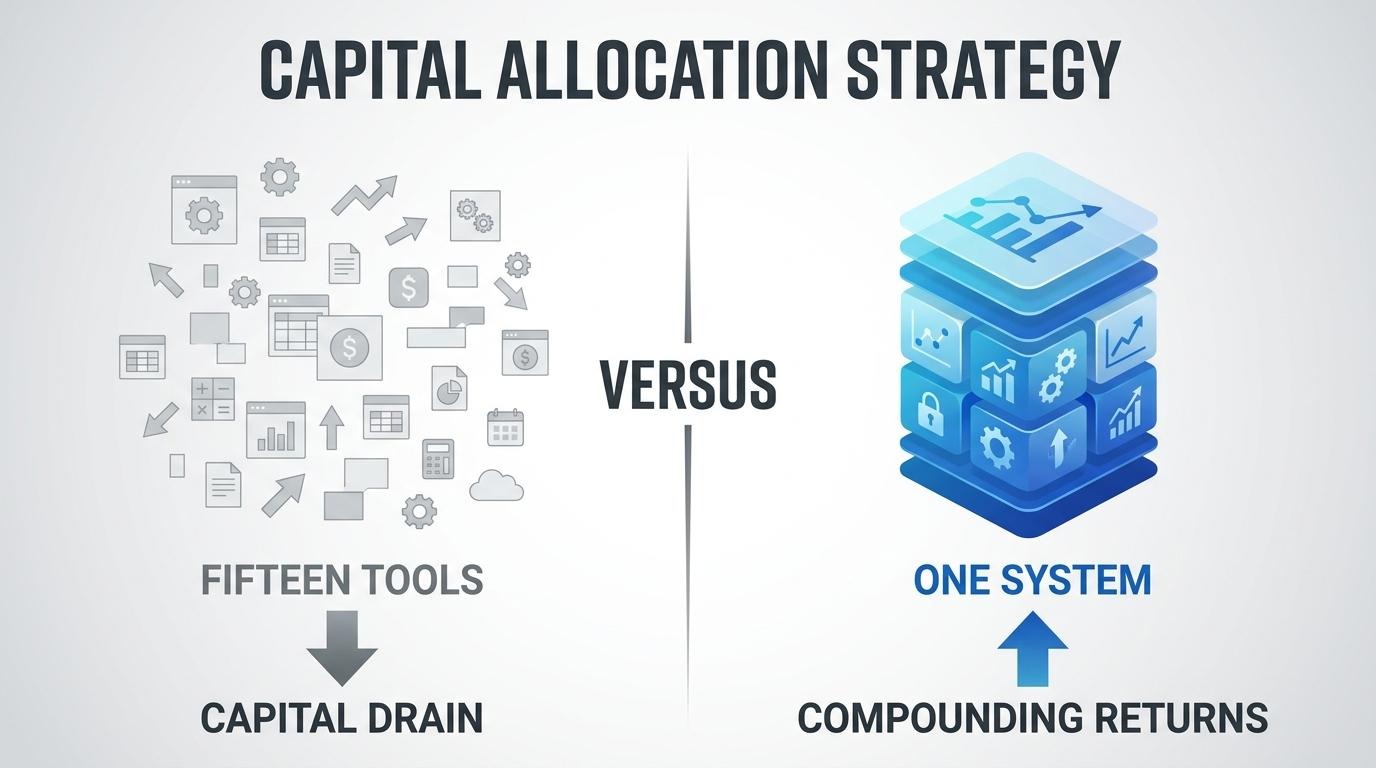
Commerce and marketing capital gains compounding returns when it lives in one system instead of fifteen separate tools. Fragmented stacks split financial capital across redundant subscriptions, each with its own data silo. Human capital gets consumed by manual reconciliation rather than strategic work, while intellectual capital (proprietary customer insights, brand equity data) scatters across disconnected dashboards where it cannot compound.
Consolidation changes the math. Financial capital concentrates into fewer, higher-impact line items. Human capital shifts from tool management to growth execution. Intellectual capital accumulates in a shared data layer where manual reconciliation is not needed. Physical capital tied to fulfillment and POS infrastructure operates from one source of truth instead of parallel systems that drift apart over time.
For brands operating at $1M to $50M in revenue, this consolidation is less about saving on app fees and more about eliminating the operational drag that can silently erode multiple capital categories. SHOPLINE is one option for brands consolidating commerce, CRM, marketing automation, subscriptions, and POS into a single system with a shared customer data layer.
The key takeaways about business capital and its four types center on one principle: capital is not just cash. Business capital encompasses financial, human, intellectual, and physical resources, and each type requires deliberate allocation to drive sustainable growth.
The most actionable insight across all four types is that they do not operate independently. Underinvesting in human capital degrades intellectual capital. Neglecting physical capital creates bottlenecks that waste financial capital. Strong capital strategy treats all four as interconnected inputs, not isolated budget lines. For scaling DTC brands especially, how capital is organized across fragmented or consolidated systems can influence whether different forms of capital reinforce each other or create operational friction.