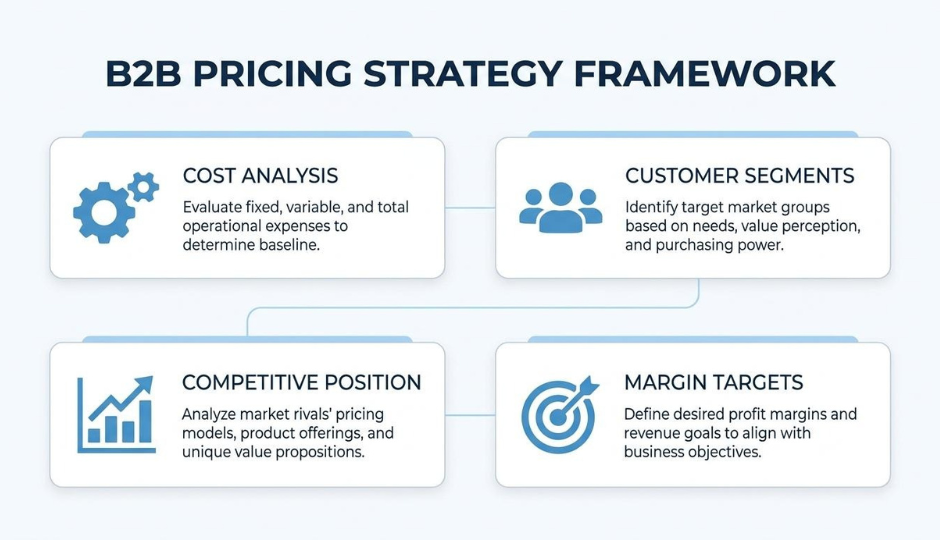
A B2B pricing strategy is a structured framework that determines how businesses set, justify, and adjust prices for other businesses based on cost structures, customer value, competitive positioning, and margin targets. In 2026, effective B2B pricing combines data-driven models with unified technology platforms to close the gap between pricing intent and execution.
This guide covers core pricing components, model selection across business types, AI-driven and rule-based tooling, step-by-step implementation, customer data integration, common mistakes, performance measurement, and unified pricing for DTC-hybrid brands.
Cost analysis, customer segmentation, competitive positioning, and profit margin targets form the structural foundation of every B2B pricing decision. Global pricing inefficiencies can reduce annual revenue by nearly a third when these components operate in isolation rather than as an integrated system.
Seven distinct pricing models serve different business conditions: cost-plus for high-volume catalogs, value-based for complex solutions, tiered for diverse buyer segments, dynamic for fluctuating markets, subscription and usage-based for recurring revenue, and contract-based for enterprise commitments. Matching the right model to product complexity and channel mix determines whether pricing captures or leaves value on the table.
AI-driven pricing tools are rapidly displacing rule-based systems, with the majority of organizations planning significant budget allocation toward agentic AI in pricing within the next one to three years. Selecting between standalone platforms, CPQ software, and ERP-integrated modules depends on catalog complexity and integration requirements.
Implementation follows a structured sequence: auditing current pricing, setting margin-aligned objectives, building testable tiers, phasing rollouts to minimize churn, and training sales teams on value narratives and discount guardrails.
Customer purchase history, lifetime value calculations, and real-time behavioral signals replace guesswork with evidence-based price setting at the segment, account, and transaction level. For DTC-hybrid brands, consolidating wholesale and retail pricing within a single platform prevents the data fragmentation that erodes margin across channels.
The core components of a B2B pricing strategy are cost analysis, customer segmentation, competitive positioning, and profit margin targets. Each element shapes how prices are set, justified, and defended across complex buying cycles.
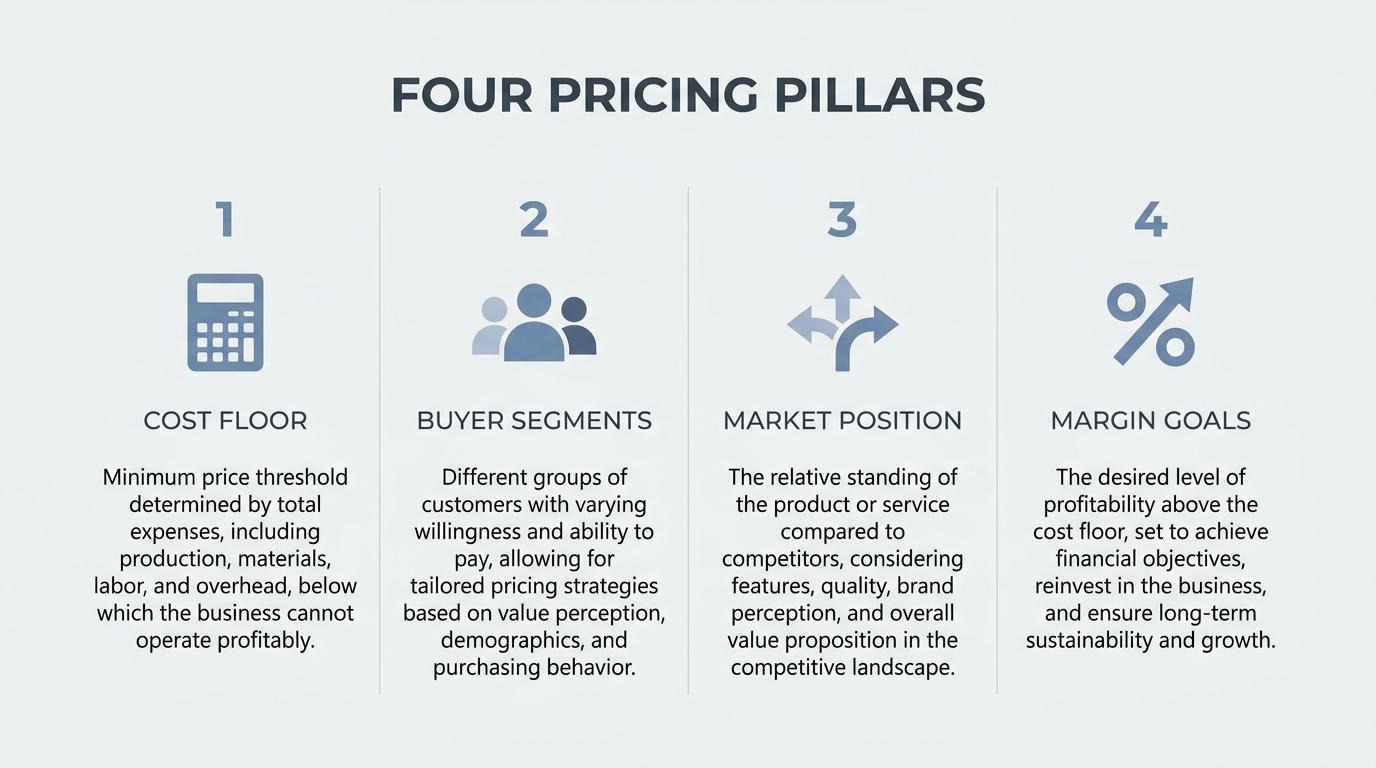
Cost analysis plays the foundational role of establishing a price floor below which no transaction remains profitable. It accounts for direct production costs, overhead allocation, distribution expenses, and customer acquisition costs.
Innovative pricing models that emphasize trial adoption rates and customer acquisition cost reduction are critical for brands competing in concentrated global industries, according to research on B2B market entry strategies published via ResearchGate. Beyond simple cost-plus calculations, modern cost analysis must also factor in pricing transparency demands. Forrester research confirms that buyers in 2026 place heightened focus on pricing transparency and value justification throughout the B2B buying process, making cost visibility a competitive requirement rather than an internal exercise.
Customer segments influence B2B price setting by determining willingness to pay, volume expectations, and service-level requirements across distinct buyer groups. Enterprise accounts, mid-market buyers, and small-volume purchasers each warrant different price architectures because their value drivers differ fundamentally.
According to a 2025 ScienceDirect study on B2B manufacturers, the implementation of value-based pricing models is non-linear and heavily influenced by the ability to explore price models jointly with customers. This means segmentation is not a one-time exercise; it requires ongoing collaboration with each customer tier to identify which pricing structures align with how they measure value. Segments defined by buying context, order frequency, and contract length produce more actionable pricing tiers than demographics alone.
Competitive positioning matters for B2B pricing because it determines whether buyers perceive your offer as premium, parity, or discount relative to alternatives. Price signals category placement. Setting prices without competitive context risks either leaving margin on the table or pricing above what the market will bear for undifferentiated offerings.
Effective competitive positioning requires mapping your product's unique value against substitutes, then pricing to reflect that differentiation. When products offer clear advantages in reliability, integration, or total cost of ownership, pricing above market parity becomes defensible. When differentiation is weak, competitive pricing must compensate through volume incentives or bundled value. For most B2B sellers, competitive positioning should inform the price ceiling while cost analysis defines the floor.
Profit margin targets shape pricing decisions by establishing the minimum acceptable return on each transaction, product line, or customer relationship. They translate business growth objectives into concrete pricing constraints.
According to OmniBound research, global B2B pricing inefficiencies can reduce annual revenue by up to 31.8% and annual margin by 17.1% when pricing is not treated as a core growth lever. Manual pricing processes compound this problem; they take three to five times longer than automated workflows and introduce errors that erode gross margin over time. Margin targets must therefore be paired with execution discipline:
Without clear margin governance, even well-designed pricing models degrade through ad hoc discounting and unmonitored exceptions. Understanding these core components prepares teams to evaluate which pricing model best fits their business.
The main types of B2B pricing models are cost-plus, value-based, tiered, dynamic, subscription-based, usage-based, and contract-based. Each model suits different business structures, buyer expectations, and revenue goals.
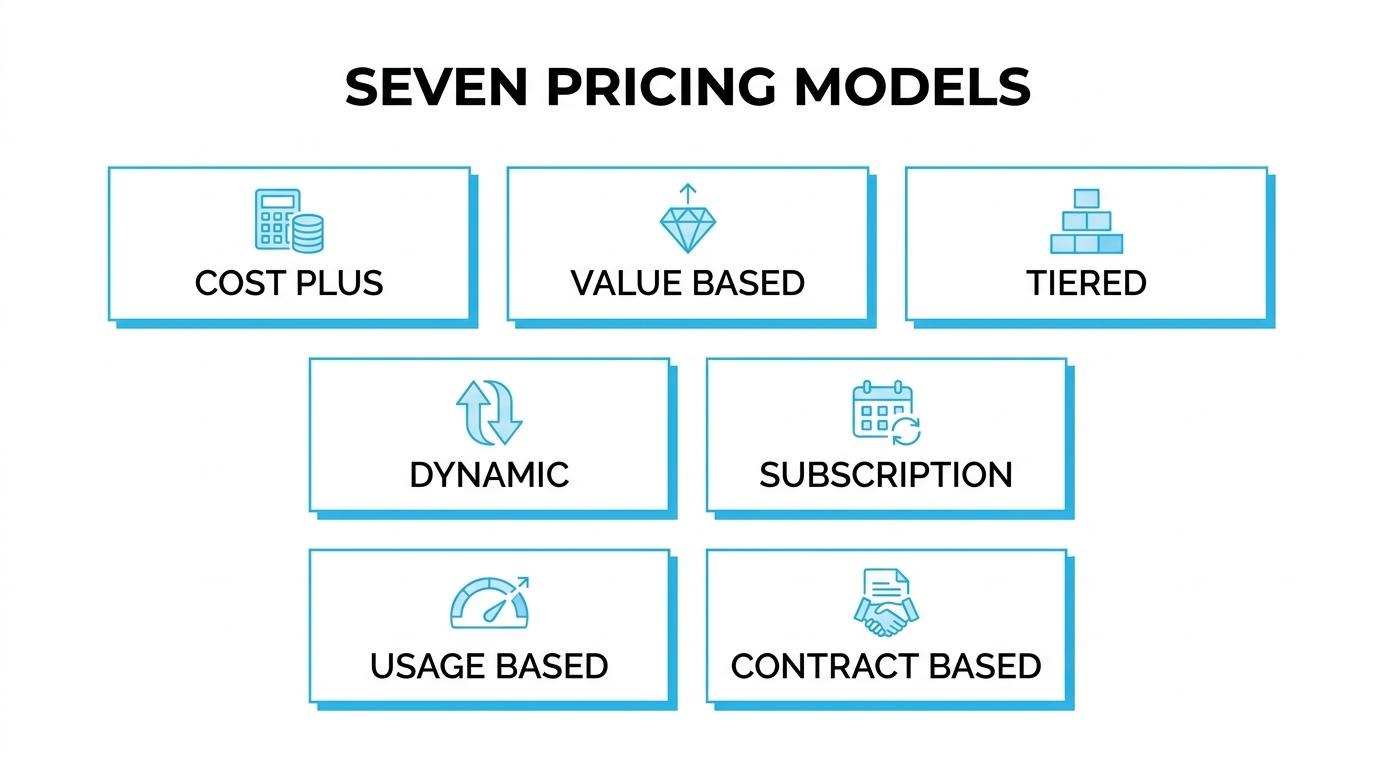
Cost-plus pricing calculates a product's total production cost and adds a fixed markup percentage to determine the final price. This model offers simplicity and predictable margins, making it common in manufacturing and distribution. However, it ignores customer willingness to pay and competitive positioning, which often leaves revenue on the table. For commodity products with stable input costs, cost-plus provides a reliable floor, but scaling brands typically layer additional models on top to capture differentiated value.
Value-based pricing sets prices according to the measurable outcomes a product or service delivers to the buyer. Rather than anchoring to internal costs, this model quantifies ROI, efficiency gains, or revenue impact for the customer. According to a 2025 ScienceDirect study on B2B manufacturers, value-based pricing implementation is non-linear and heavily influenced by the ability to explore price models jointly with customers. This collaborative approach requires robust customer data but consistently captures higher margins when executed well.
Tiered pricing structures multiple packages at different price points, each offering progressively more features, capacity, or service levels. This model serves diverse buyer segments within a single product line. Common tier differentiators include:
Tiered pricing reduces friction for smaller buyers while creating natural upsell paths as accounts grow.
Dynamic pricing adjusts prices in real time based on market conditions, demand signals, inventory levels, or competitive positioning. Algorithms process variables continuously to optimize margins without manual intervention. This model works best for businesses with high transaction volumes and fluctuating supply-demand curves. The risk lies in buyer perception; B2B customers expect pricing consistency, so transparency around adjustment criteria is essential to maintain trust during price shifts.
Subscription-based pricing charges buyers a recurring fee at regular intervals for continued product or service access. This model generates predictable revenue streams and simplifies financial forecasting for both seller and buyer. Subscriptions work particularly well for software, managed services, and consumable supply agreements. The trade-off involves higher initial acquisition costs offset by compounding lifetime value, making retention strategy as critical as acquisition.
Usage-based pricing charges customers based on actual consumption rather than flat fees. Recent data from L.E.K. Consulting indicates that 85% of SaaS companies are already using or implementing usage-based pricing strategies to align revenue with actual product value. A 2026 Salesforce survey of more than 4,000 sales professionals found that 76% of sales leaders believe usage-based pricing is more important to their customers now than in the previous year. This model rewards efficient customers and scales naturally with account growth; it represents the strongest alignment between vendor delivery and buyer spend in B2B.
Contract-based pricing locks in negotiated rates for a defined term, typically spanning one to three years. Buyers receive price stability and often volume discounts, while sellers gain revenue predictability and reduced churn risk. Terms commonly include:
For complex enterprise deals, contracts remain the default structure because they formalize mutual commitment across long sales cycles.
With these models defined, the next step is matching each one to specific business conditions and buyer profiles.
You choose the right B2B pricing model by matching it to your product complexity, sales volume, revenue structure, and channel mix. The following sub-sections break down which models fit high-volume goods, custom solutions, recurring revenue, and marketplace channels.
The model that works for high-volume low-margin products is cost-plus pricing. Cost-plus pricing adds a fixed percentage markup to production and fulfillment costs, making it predictable across thousands of SKUs where individual negotiation is impractical. Volume-based tiered discounts layered on top reward bulk buyers without eroding baseline margins.
For commodity-type goods, this approach keeps pricing administration lean. According to Zilliant, manual pricing processes take three to five times longer than automated workflows and compound errors that erode gross margin. Automating cost-plus calculations at scale eliminates that drag. For brands managing large catalogs, the simplicity of cost-plus is often underestimated; it frees pricing teams to focus strategic effort where margins are actually flexible.
The model that works for custom or complex solutions is value-based pricing. Value-based pricing anchors the price to the measurable outcome or ROI the buyer receives rather than to internal production costs. When solutions are configured per client, cost structures vary too widely for standardized markup to capture the full value delivered.
A 2025 ScienceDirect study on B2B manufacturers found that value-based pricing implementation is non-linear and heavily influenced by the ability to explore price models jointly with customers. This means sellers of complex solutions should co-develop pricing frameworks during discovery, tying price points to quantifiable buyer outcomes such as downtime reduction or efficiency gains. Contract-based pricing often complements this approach by locking in negotiated terms over multi-year engagements.
The model that works for recurring revenue businesses is subscription-based or usage-based pricing. Subscription pricing delivers predictable monthly or annual revenue with tiered feature access, while usage-based pricing scales charges with actual consumption.
According to a 2026 Salesforce survey of more than 4,000 sales professionals, 76% of sales leaders believe usage-based pricing is more important to their customers now than in the previous year. Hybrid models combining a base subscription fee with metered overages offer both revenue stability and flexibility. For SaaS and service businesses, matching the pricing cadence to how customers extract value reduces churn and aligns incentives across the contract lifecycle.
The model that works for marketplace or wholesale channels is tiered pricing with segment-specific catalogs. Tiered pricing assigns different price levels based on buyer classification, order volume, or contractual terms, which is essential when serving distributors, retailers, and direct buyers simultaneously.
Managing separate price lists across channels without a unified system creates inconsistencies that erode trust. SHOPLINE's B2B catalogs allow merchants to assign tailored pricing to specific wholesale buyer segments while running DTC pricing in the same platform, removing the sync issues that arise from managing separate tools. For brands selling across multiple wholesale accounts and marketplaces, segment-level catalog control is the operational foundation that prevents channel conflict.
With the right model matched to your business type, the next step is selecting tools that can execute and scale that pricing logic.
The best B2B pricing tools available in 2026 span AI-driven optimization platforms, CPQ software, and ERP-integrated modules. Choosing the right tool depends on catalog complexity, sales workflow, and integration requirements.
You should look for a B2B pricing platform that supports your specific pricing model, integrates with existing systems, and scales with transaction volume. Key evaluation criteria include:
For brands managing both wholesale and direct channels, platforms with a shared data layer eliminate the reconciliation burden that multi-tool setups create. The right platform reduces operational drag rather than adding another integration to maintain.
AI-driven pricing tools differ from rule-based tools by learning from historical transaction data, market signals, and buyer behavior to generate price recommendations autonomously. Rule-based tools apply static logic: if order volume exceeds X, apply Y discount. AI-driven systems continuously recalibrate based on patterns that static rules cannot detect.
According to a November 2025 McKinsey Agentic AI in Pricing Survey of more than 400 pricing executives, 65 to 85 percent of organizations expect to adopt generative AI or agentic AI in pricing over the next one to three years, up from 10 to 30 percent in early 2026. Budget allocation reflects this shift; over 55 percent of organizations plan to dedicate more than 30 percent of their pricing technology budgets to agentic AI during that same period.
Rule-based tools still work well for straightforward catalogs with predictable demand. When deal complexity rises and margins narrow, though, AI-driven systems deliver the responsiveness that static rules cannot match.
A business needs dedicated CPQ (configure, price, quote) software when its sales process involves customizable products, complex bundling, or negotiated pricing that standard ecommerce checkout cannot handle. Common triggers include:
If your sales team spends more time building quotes than selling, CPQ eliminates that friction. For businesses with simpler catalogs and fixed pricing tiers, built-in ecommerce pricing tools typically suffice without the added implementation overhead.
ERP-integrated pricing tools compare to standalone solutions by offering tighter alignment with inventory, cost, and financial data at the expense of flexibility. Standalone pricing platforms prioritize agility, advanced analytics, and faster deployment cycles.
The trade-off is clear: ERP-integrated tools reduce data silos but inherit the slower update cadence of enterprise systems. Standalone platforms move faster but require reliable data feeds from your ERP to stay accurate. For most scaling B2B operations, the decision hinges on whether pricing agility or system consolidation matters more to the next stage of growth.
You implement a B2B pricing strategy step by step by following a structured framework: auditing current pricing, setting objectives, building tiers, rolling out changes, and training sales teams.
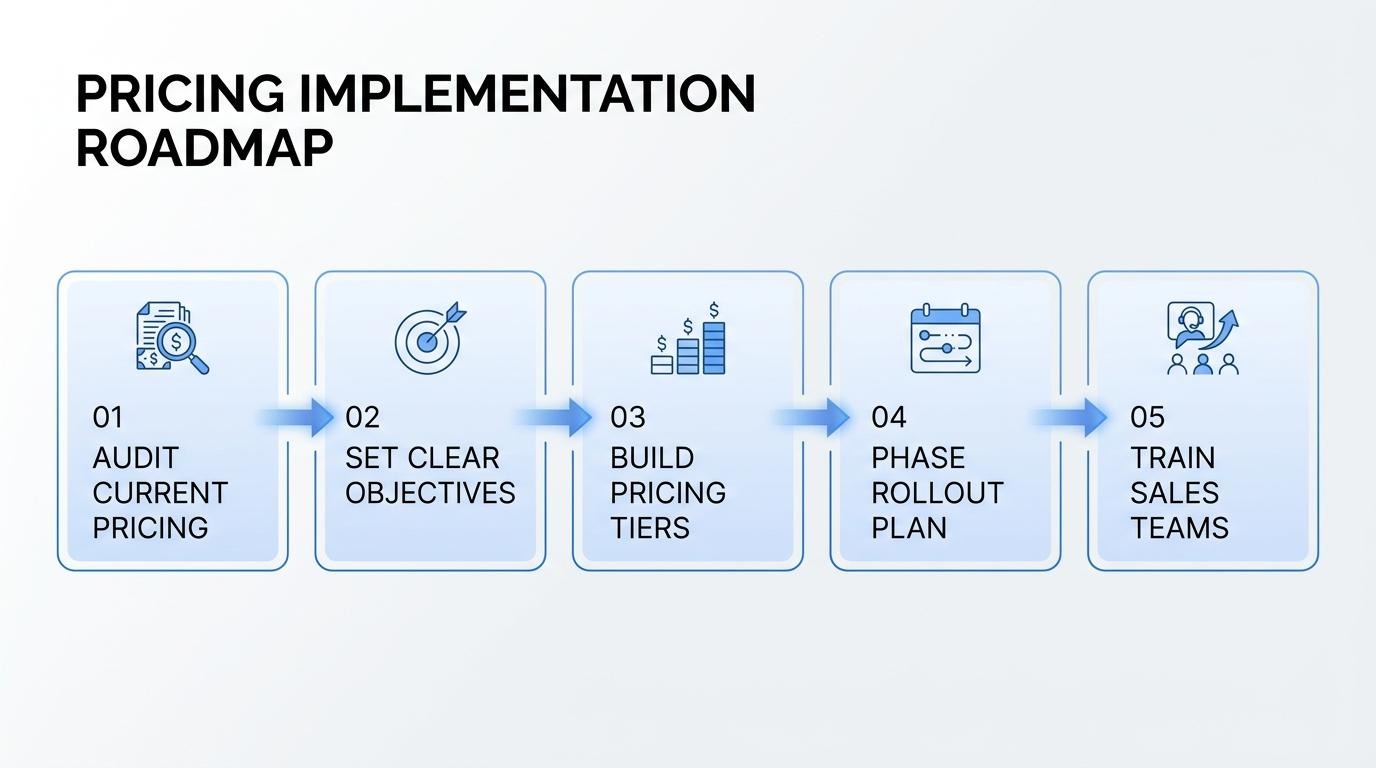
You audit your current pricing structure by cataloging every active price point, discount, and contract term across customer segments. This means pulling data from your CRM, ERP, and any manual spreadsheets where pricing lives.
A thorough audit examines:
The goal is identifying where revenue leaks occur, whether through inconsistent discounting, outdated list prices, or segment misalignment. Without this baseline, any new strategy builds on guesswork.
You set pricing objectives aligned to growth goals by connecting price targets directly to specific business outcomes, such as margin expansion, market share capture, or customer retention. Pricing objectives must translate corporate strategy into measurable pricing actions.
According to McKinsey research, a 1 percent price increase translates into an 8.7 percent increase in operating profits for B2B organizations, assuming no volume loss. This asymmetric leverage makes objective-setting critical; small directional choices compound significantly.
Common pricing objectives include:
Each objective should have a timeline, an owner, and a measurable KPI attached.
You build and test pricing tiers or brackets by defining clear value fences between each level, then validating willingness-to-pay through controlled experiments. Each tier must offer a distinct set of features, service levels, or volume thresholds that justify its price point.
Effective testing involves:
Tiers fail when the gaps between them are too narrow or the upgrade incentive is unclear. For most B2B brands managing wholesale and direct channels simultaneously, tier architecture should reflect buying context, not just volume.
You roll out new pricing without losing customers by phasing changes gradually, communicating value justification early, and grandfathering existing contracts where appropriate. A 2026 Zilliant survey found that 62% of companies report losing customers directly tied to pricing changes, despite record investment in pricing strategies.
To minimize churn during a pricing transition:
The execution matters more than the number itself. Customers leave when they feel blindsided, not when prices rise with clear rationale.
You train sales teams on new pricing frameworks by equipping reps with value narratives, discount guardrails, and practice scenarios before any customer-facing conversation. Ernst & Young research indicates that companies improving pricing execution can lift EBIT by 2 to 5 percent of sales.
Effective training programs include:
Sales enablement is where pricing strategy succeeds or fails at the point of transaction. Without structured reinforcement, reps default to discounting under pressure, eroding the margins that pricing architecture was designed to protect.
With implementation steps defined, tracking performance metrics ensures the strategy delivers measurable results.
Customer data improves B2B pricing decisions by revealing patterns in purchase behavior, customer value, and real-time engagement that replace guesswork with evidence-based price setting. The following subsections cover segment-level pricing from purchase history, discount thresholds from lifetime value, and dynamic pricing from behavioral signals.
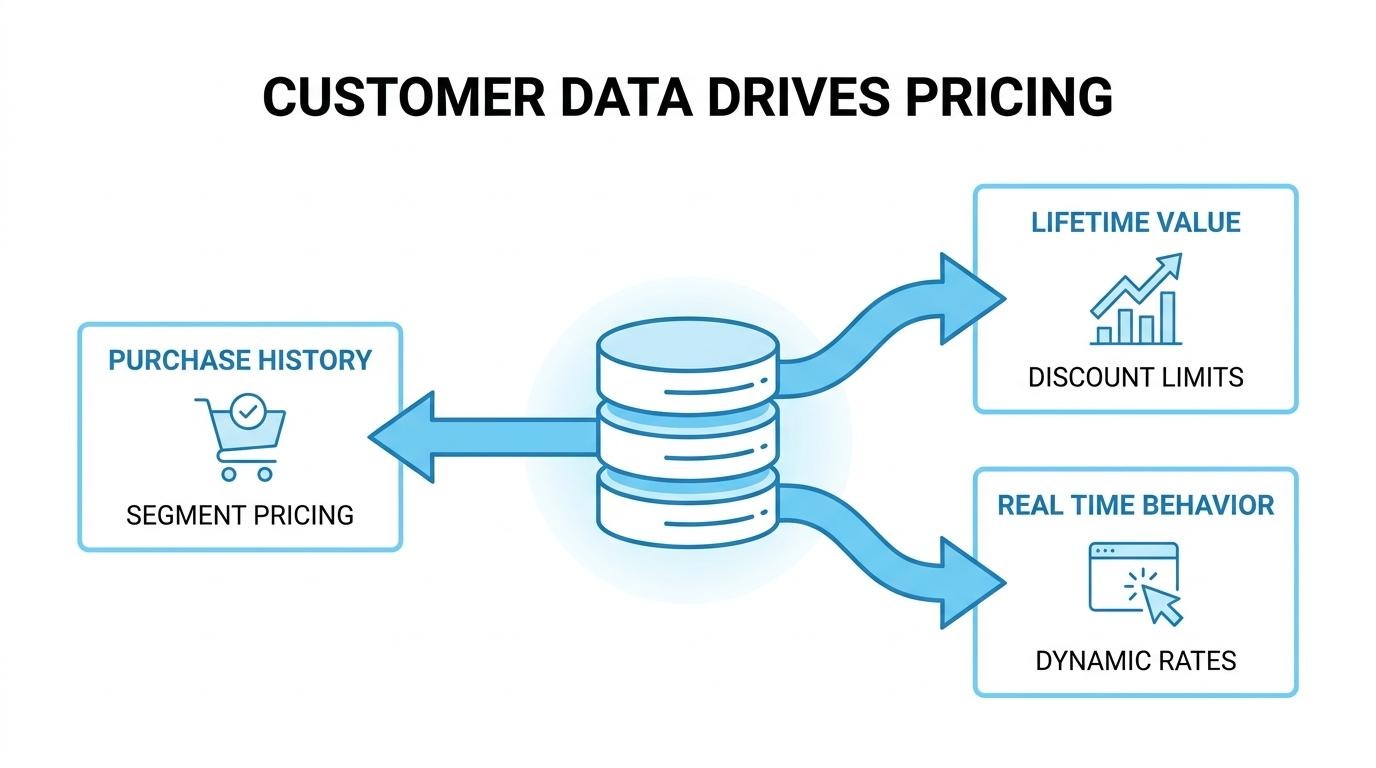
Purchase history informs segment-level pricing by revealing order frequency, average order value, product mix preferences, and price sensitivity across distinct buyer groups. When these patterns are mapped to customer segments, pricing teams can set tier-specific rates that reflect actual buying behavior rather than assumed willingness to pay.
Key signals extracted from purchase history include:
A 2025 systematic literature review published in IJRISS on B2B customer profitability found that traditional cost-based pricing is increasingly being replaced by digitalized, data-driven frameworks that evaluate customer value through quality assessment indicators. This shift makes granular purchase history the foundation for defensible, segment-specific pricing rather than blanket markups.
Lifetime value data guides discount thresholds by quantifying the total revenue a customer is expected to generate, which sets a rational ceiling on how much margin can be sacrificed to retain or expand that account. Without LTV context, discounts become arbitrary concessions that erode profitability.
Effective LTV-based discount governance follows a clear logic: high-LTV accounts justify deeper discounts because the long-term revenue offsets short-term margin loss, while low-LTV accounts receive minimal concessions. For most B2B organizations, anchoring discount authority to projected lifetime value prevents the common failure of giving away margin to accounts that will never return it. According to McKinsey, a 1 percent price increase translates into an 8.7 percent increase in operating profits, assuming no volume loss. That ratio makes undisciplined discounting especially costly for accounts where LTV does not justify the concession.
Real-time behavior data enables dynamic pricing by feeding live signals into pricing algorithms that adjust offers based on current buyer intent, inventory levels, and competitive context. Unlike static price lists, dynamic systems respond to browsing patterns, cart activity, quote request urgency, and session frequency.
Behavioral triggers that inform dynamic adjustments include:
Only 5 to 10 percent of organizations have fully scaled agentic AI across pricing use cases in early 2026, according to a November 2025 McKinsey survey of more than 400 pricing executives, though 40 to 60 percent report active scaling efforts. The gap between intent and execution here represents a competitive advantage for brands that operationalize behavioral data now rather than waiting for full market adoption.
With customer data shaping pricing at the segment, account, and moment level, avoiding common mistakes becomes the next priority.
Common B2B pricing mistakes to avoid in 2026 include relying on manual processes, ignoring customer data, underinvesting in pricing governance, failing to communicate value during price changes, and treating pricing as a static cost-recovery exercise rather than a strategic growth lever.
The most damaging errors fall into these categories:
For scaling brands running complex B2B operations, these mistakes often compound when pricing logic lives across disconnected tools. The most effective correction is consolidating pricing rules, customer segmentation, and order data into a single system that enforces governance at the point of transaction.
Understanding these pitfalls is only half the equation; measuring pricing performance reveals whether corrections are working.
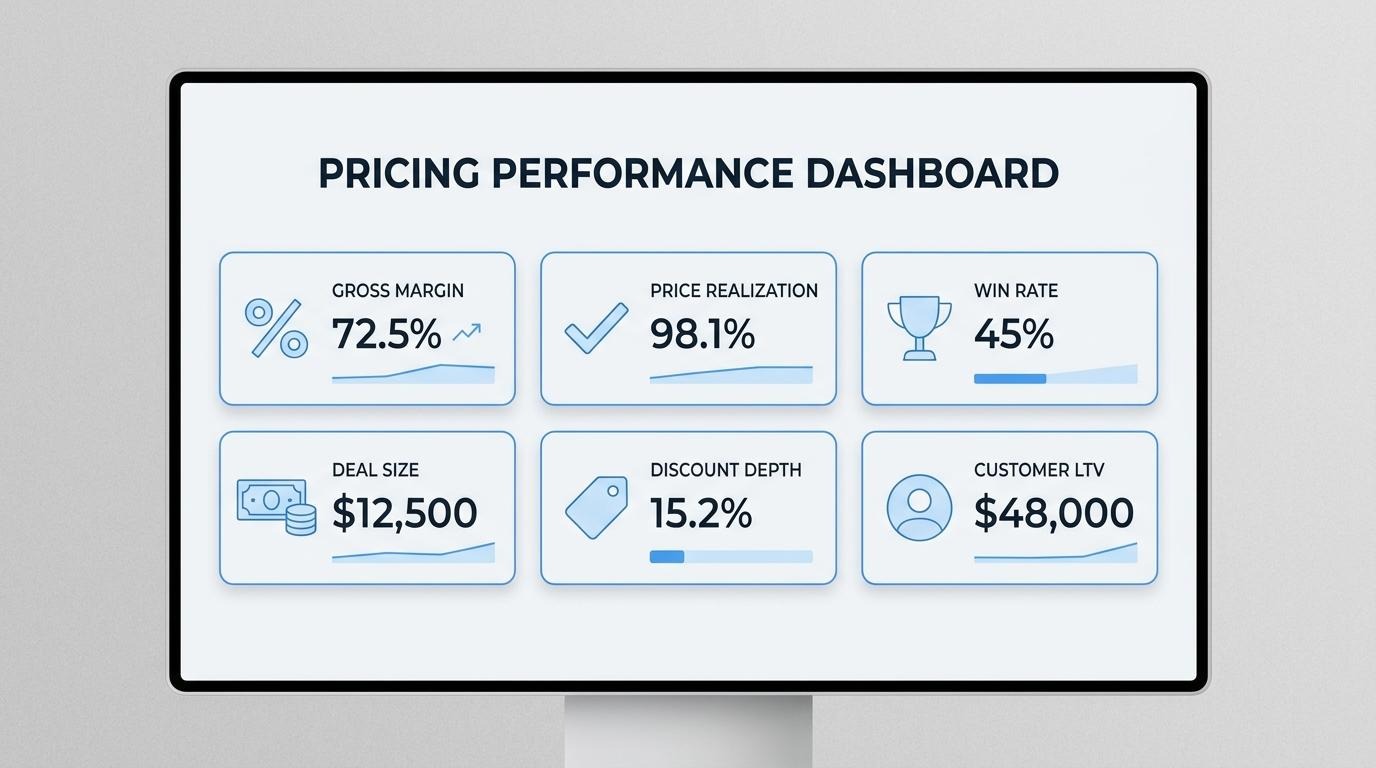
You measure B2B pricing strategy performance by tracking financial KPIs tied to margin, revenue realization, and win rates, then reviewing results on a regular cadence.
The KPIs you should track for pricing effectiveness include:
According to McKinsey, a 1 percent price increase translates into an 8.7 percent increase in operating profits for B2B organizations, assuming no volume loss. That leverage makes even small measurement gaps costly. Tracking these KPIs monthly gives pricing teams the visibility to act before margin erosion compounds.
You should revisit and adjust B2B pricing at least quarterly, with a comprehensive strategic review every six months. A five-step B2B pricing framework published by OmniBound recommends governing negotiations with bi-annual refinements as the final stage of price architecture management.
Quarterly reviews should examine deal-level data, discount trends, and competitive shifts. Semi-annual reviews assess whether the pricing model itself still aligns with customer segments and market conditions. Businesses operating in volatile supply chains or fast-moving categories often benefit from monthly micro-adjustments layered on top of that cadence.
For brands managing pricing across wholesale and direct channels, this review rhythm becomes even more critical to prevent channel conflict and margin leakage.
B2B pricing strategy changes for DTC-hybrid brands by requiring unified price management across wholesale and retail channels within a single system. The following sections cover managing dual pricing, data fragmentation risks, platform consolidation, and key takeaways.
You manage wholesale and DTC pricing in one system by maintaining separate price lists, customer-specific catalogs, and tiered discount rules within a shared commerce backend. The system must distinguish buyer types at login, surfacing wholesale MOQs and volume breaks for B2B accounts while displaying retail pricing for DTC shoppers.
Key requirements for unified pricing management include:
Without this architecture, brands default to running parallel storefronts, which doubles operational overhead and creates margin inconsistencies between channels.
What happens is pricing decisions lose accuracy, segment-level insights fragment, and margin leakage compounds across channels. When wholesale buyer behavior lives in one CRM while DTC purchase history sits in another, no single view reveals true customer lifetime value or cross-channel buying patterns.
The practical consequences include:
For brands operating at scale, this fragmentation is not a minor inconvenience; it directly undermines the data-driven pricing frameworks replacing traditional cost-based approaches.
SHOPLINE unifies pricing and customer data without app sprawl by housing B2B catalogs, tiered pricing, CRM, and DTC commerce inside one platform with a shared customer data layer. Rather than connecting separate wholesale portals, pricing apps, and CDPs through integrations, SHOPLINE resolves every buyer to a single record regardless of channel.
A 2025 systematic literature review published in IJRISS confirms that traditional cost-based pricing is increasingly replaced by digitalized, data-driven frameworks evaluating customer value through quality assessment indicators. SHOPLINE's architecture supports this shift natively: B2B catalogs allow customized product pricing for different customer segments, enabling businesses to assign tailored catalogs to specific wholesale buyers without bolting on third-party tools.
For hybrid brands at the $1M to $50M range, this consolidation eliminates the sync failures and data gaps that erode pricing precision across channels.
The key takeaways about B2B pricing strategy in 2026 center on execution gaps, AI adoption timelines, and the critical importance of unified data infrastructure.
The gap between pricing ambition and pricing execution defines 2026. Brands that unify their data infrastructure before layering in AI-driven pricing will capture margin improvements far sooner than those still reconciling fragmented tools.